A while ago I had the pleasure of the company of "Darius", who is in that interesting not-quite-a-toddler, not-quite-a-preschooler stage.
Now, let it not be said that I experiment on the children I babysit, but one part of my brain was very interested in what Darius would seek out for play experiences. (Okay, okay, so I may have incorporated a little bit of research into my supervision.) He had never been to our farm before; he had never met me before. I wondered if he would be more comfortable inside playing with my quite large collection of age-appropriate toys, or if he would naturally tend towards more risky play, the exploration of the unknown outdoors. I decided to just let him lead, and see what happened.
Well, the first thing that happened was that he clung to dad's leg and hid his face. Pretty normal.
"Don't be shy, Darius," said dad, obviously a bit embarrassed. "Say hello."
"That's okay," said I to dad, smiling at Darius who was peeking around dad's leg by now. "He's never been here before and he doesn't know me. He doesn't have to say hello if he's not ready yet."
To Darius, I said, "You can be shy if you want to, Darius. It's all new, isn't it?"
Instant eye contact. It's amazing how recognising and naming a child's feelings, without judgment, can cut through the ice. It was all easy from there on in; he stayed with dad, but he was watching me and listening to me.
The first thing to separate Darius from the safety of dad's leg was not a shiny, colourful toy. It was this.
I guess that's not surprising. The turkey chicks are still small enough to be cute and non-threatening. Darius spent some time happily chasing them through the bush. (Um, yes, through the bush.) Totally focussed, totally without fear.
I followed at a trot through the trees, thinking the usual carer-risk-assessment thoughts.
What if he falls over and lands on a stick and (insert dreadful injury)?
Don't be daft. Look at him. He's absolutely competent on his feet, and he's picking his way through the trees and avoiding sticks on the ground perfectly well. Probability: minimal.
All the time, I was consciously stopping myself from saying "Be careful!" He WAS being careful. The last thing he needed was me distracting him from what he was doing. But yes, it was an effort to shut myself up!
Snakes?
Probability: minimal. The weather's way too cool. But I'll keep a little ahead of him now, just in case.
Then I realised that the turkeys would tell me if a snake's around long before human eyes spotted it, and relaxed. There's about as much chance of stepping on a snake here as there is of being involved in a major car accident driving to the shops. And that's only in high summer, not in autumn.
At one point, back in the clearing, he sloughed his shoes and continued running barefoot.
What if he steps on a bull-ant?
I mentioned this to dad, and he replied "Well, he won't do it again, will he?"
Bravo, dad. To my knowledge no-one's ever died from being bitten by a bull-ant, though it's an unpleasant experience. And once bitten, yes, you do start to look out for them to prevent it from happening again.
It was really good for me to engage in this type of in-the-wild supervision- experiences like this stop me from being too glib about advertising risky play as though it's easy for carers to achieve. Fifteen minutes of this, in a genuinely untamed bit of bush, reminded me of the very real fears that go through our minds when we let kids free-range. Yes, I really do appreciate how easy and attractive it is to confine children to bland, 'safe' areas, to try to avoid having to do this on-the-run risk assessment. Yes, it's quite mentally and emotionally taxing to let kids test themselves. Yes, you do feel fearful that something will go wrong, that you'll be held responsible.
But honestly, it's worth it. All the time Darius had been on the run, he'd been asking questions about the birds, and I'd been answering as well as pointing out other interesting things to see. By the time he'd tired of chasing the turkeys, Darius was grinning, relaxed, talking twenty to the dozen and ready to accept me as his carer for the morning.
Had he run off his nerves? Maybe. Or was he just appreciating not being thwarted, being allowed to do what felt good to him? Maybe.
Here are some more things that attracted Darius' attention, once he'd accepted me:
Now, let it be said that my dog is the safest dog in the world for a little kid to play with, and Darius was used to dogs. I definitely do NOT recommend letting a 2-year-old approach any old dog that takes their fancy. That's not risky play, that's just downright dangerous. The trick is to teach them some boundaries around dogs in general, and if that means grabbing their hands and saying firmly "I won't let you do that", go for it. You really do have to reinforce that approaching strange dogs is OUT.
Darius had already been taught a little caution by his parents, and so he was quite safe patting my very friendly dog. Even so, I stayed right there next to him. You just never know.
These also caught his eye:
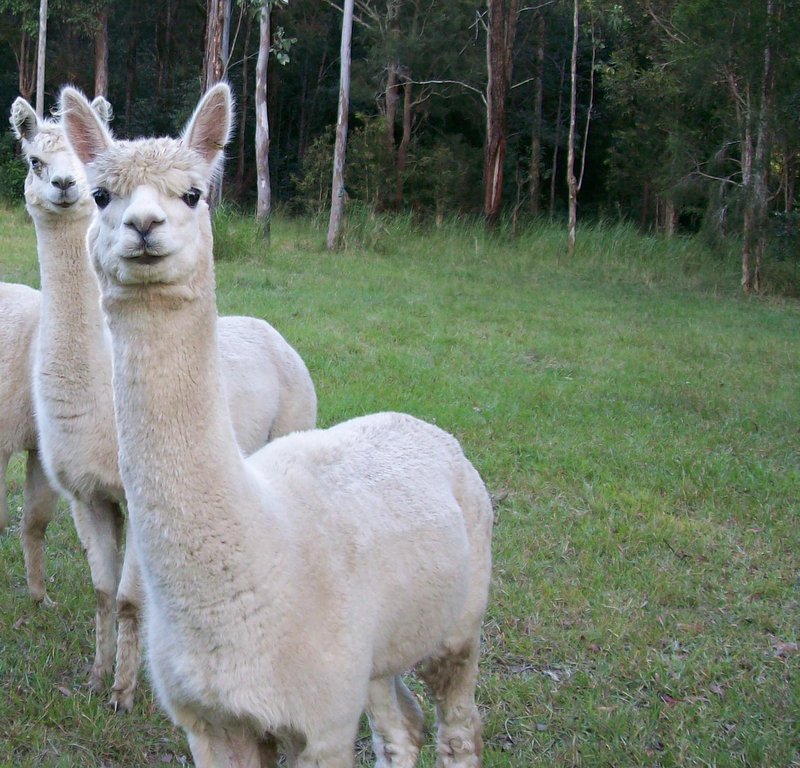
Again, these are well-behaved animals, and they're also very shy- but they're large, heavy animals nonetheless, and so I stayed close by while Darius inspected them from a rather cautious distance. He didn't show any inclination to touch them, once we were close enough for him to see how big they were.
Darius was actually more taken by this:
My bottle-reared sheep provoked a very interesting risk dynamic. You see, she thinks she's a dog. So she had no hesitation in walking right up to Darius looking for food, and he showed immediate awareness of his limits by hiding behind my leg. Right up close, she might not have been as big as the alpacas, but she was as tall as him and clearly far, far bulkier.
I interacted with her for a short time, talking to Darius about her, and he gradually relaxed again- but still wouldn't touch her. You see? He had a natural awareness of some danger to his person- probably a natural reaction to the sheep's size compared to his own.
We often don't need to press the point. If something's lethal, we shouldn't have a child near it. Otherwise, we need to allow our kids a bit more space to assess a risk, before we move in with our own fears. Let their instincts develop naturally.
When Darius had a bit more confidence in the layout of the farm, he did something a bit more risky; he decided to take off to 'find' the alpacas by himself. I let him go off across the clearing, watching from a distance. (Yes, he thought he was ready to go wandering on a strange farm at two and a half. I bit back the natural tendency to stop him.)
Well, not only did he find the alpacas- he found my sheep too, and she ran towards him excitedly. Freak-out! Darius screamed, turned and ran back to me sobbing.
I picked him up, out of reach of my pushy wanna-be-a-dog give-me-food black sheep, and he quickly regained his composure.
So what do we make of that? Was it a terrible thing to do, letting him run off by himself to get a big fright?
I don't think so. There was no real danger present. Darius tested his limits and found them; end of story. He didn't try to run off by himself again all morning. Surely that's a good thing. When we let kids take risks, they learn.
I mean, if I'd forbidden him to go off across that paddock by himself, would he have tried to sneak away when I was distracted? There are dams on our property too. There are gullies with water at the bottom. There are long tracks through tall trees and thick bush, where even I've got lost once or twice.
No, no, no. Much better that he found his own limits, while I watched from afar.
At one stage, when I needed to go into the house for a while, I offered Darius some toys. This is what I offered him:
You know, he really wasn't much interested. He played with the bus for a while, rolling it down the ramp, but he found this much more interesting:
Children like real tools- tools that adults can play with too. They don't always need to have scaled-down, pretend toys.
Yes, it was noisy. I lived. I bit my tongue again when he bashed his hands down, waiting for the moment when he'd find a different way of playing. He did. I just had to be patient, survive the loud bit, and wait for him to discover playing with one finger, playing with two fingers, playing softly.
We played elephant music. We played mouse music.
And soon after this, he wanted to go outside again, where he played with these:
You can see how tiny those flowers are- those are my fingers next to the yellow one. He found all these playthings himself. He examined them, and collected them, and brought them back to the house to play with some more.
Yes, he played with sticks. He chose small ones, in proportion to his body. I didn't stop him. He didn't hurt himself.
Thus we spent a whole morning, a two and a half year old and a lady who had been a total stranger at the start, with only one little moment of tearfulness and not a single whine.
And what does all this tell me, that can be useful to you?
It tells me that children respond to being treated with respect. That child didn't even want to look at me when he arrived. With respectful treatment that acknowledged his space and his needs and his feelings, by the end of the morning he was cuddling me fiercely and not wanting to leave!
It tells me that we have to have more confidence in young children. We don't have to constantly entertain them. We don't have to treat them as though they have no concept whatsoever of risk. We would be well advised to get them outdoors, tape our mouths shut and let them exercise their bodies, entertain themselves and develop their risk assessment skills even further.
It tells me that children don't need to be patronised. We would be well advised to give them access to adult tools now and then- carefully chosen, perhaps, but the real thing- tape our mouths shut and let them explore.
It tells me that the world outdoors is full of children's toys. We would be well advised to tape our wallets shut, stop buying brightly coloured plastic cr*p and stuff we think our children might want, and let our children find their own playthings. Toys that are, truly, their own choice.
Children are more capable than we think. And if we allow them the room, if we bite our tongues and give them some respect along with the boundaries, they will constantly surprise us with their ability to entertain themselves.
LIKE Aunt Annie on Facebook
Friday, April 27, 2012
Friday, April 20, 2012
Happiness, pleasure and the joy of being broke
There's a wonderful lyric from Malcolm Williamson's opera version of Oscar Wilde's 'The Happy Prince' that has always made me thoughtful. The prince is indulged in all things material, and never allowed to feel sorrow. After his death, he becomes a statue looking out over the misery of poverty outside the walls of his palace; it touches his leaden heart with pity, and he sadly sings:
"My courtiers called me The Happy Prince,
And happy indeed I was- if pleasure be happiness."
I think pleasure and happiness are words that we need to define very carefully in our parenting. So often we do something on the pretext that it will make our children happy, yet in fact what we're doing is giving our children pleasure.
And when the ability to give our children pleasure at the drop of a hat is taken away- usually by a change of circumstances such as the loss of a job, a relationship break-up or an illness that affects our income- we worry that we will no longer be able to make our children happy.
Let me just reassure you on that point.
"My courtiers called me The Happy Prince,
And happy indeed I was- if pleasure be happiness."
I think pleasure and happiness are words that we need to define very carefully in our parenting. So often we do something on the pretext that it will make our children happy, yet in fact what we're doing is giving our children pleasure.
And when the ability to give our children pleasure at the drop of a hat is taken away- usually by a change of circumstances such as the loss of a job, a relationship break-up or an illness that affects our income- we worry that we will no longer be able to make our children happy.
Let me just reassure you on that point.
Monday, April 16, 2012
I Will Not Pin.
Oh my. Everyone, but everyone, seems to have gone suddenly crazy for Pinterest.
Not me. I have decided that I Will Not Pin. And it's not just because I'm a jumper-off from bandwagons, though that's true. All my life, if everyone was wearing mulberry and taupe, I was in black and scarlet; if everyone was coming out of the movie theatre drooling about "Titanic" or "American Beauty", I was running the other way screaming "GARBAGE!".
(Don't start me. Please.)
So perhaps I was inclined not to pin from the start. But honestly, contrary nature aside, my rational brain can think of plenty of reasons not to pin.
(You're wondering what this has to do with childcare, aren't you? Bear with me. I always get there in the end.)
Not me. I have decided that I Will Not Pin. And it's not just because I'm a jumper-off from bandwagons, though that's true. All my life, if everyone was wearing mulberry and taupe, I was in black and scarlet; if everyone was coming out of the movie theatre drooling about "Titanic" or "American Beauty", I was running the other way screaming "GARBAGE!".
(Don't start me. Please.)
So perhaps I was inclined not to pin from the start. But honestly, contrary nature aside, my rational brain can think of plenty of reasons not to pin.
(You're wondering what this has to do with childcare, aren't you? Bear with me. I always get there in the end.)
Thursday, April 12, 2012
Sibling bullies
Parenting is a tightrope to walk. I know that. It's so hard not to fall off one side or the other of that thinnest of thin lines- into over-regulation, or into permissiveness- even when you're trying your hardest.
But sometimes I see the chaos caused by well-meaning parents who misinterpret where the line is, and my heart bleeds for the kids, and I have to say something. LOUDLY. Today I'm saying something, LOUDLY, because yet again I've seen a child in pain when parents thought they were doing the right thing.
See, there's lots been said about how we shouldn't intervene too much between siblings. Let them sort it out. Don't force the relationship. And I agree with that, within reason.
But let me show you what can happen when that approach gets taken too far. It's not pretty.
But sometimes I see the chaos caused by well-meaning parents who misinterpret where the line is, and my heart bleeds for the kids, and I have to say something. LOUDLY. Today I'm saying something, LOUDLY, because yet again I've seen a child in pain when parents thought they were doing the right thing.
See, there's lots been said about how we shouldn't intervene too much between siblings. Let them sort it out. Don't force the relationship. And I agree with that, within reason.
But let me show you what can happen when that approach gets taken too far. It's not pretty.
Sunday, April 8, 2012
The Richest Crocodile: Earth Day Blog Hop
The Richest
Crocodile
in the World
by Daniel Postgate
Published by HarperCollins, 2003
ISBN-T3: 978-0-00-780985-1
Earth Day Theme: Water and Sun
I have to admit that I love this book. I found it going cheap in the supermarket one day as though it was remaindered, but it grabbed me at once and the kids adored it too. It ticks so many boxes in the preschool room!
I mean, just look at that crocodile- did I mention that 'crocodile' is a magic word? I could read them Pride and Prejudice and they'd listen, if only D'Arcy were a crocodile.
And look at all those boys' toys that the rich crocodile has to play with! Helicopters, cars, bikes... oh yes, they're listening alright, those sometimes-twitchy and hard-to-settle boys.

If you don't know the story, here's a brief run-down:
The rich crocodile looks out across the plains and sees the other animals having fun horsing around in the waterhole.
He tries having that sort of fun by himself, but he's missing one important ingredient- FRIENDS!

So off he goes with his butler, the giraffe, to join in.
But when he gets there, the waterhole has dried up and the animals are all gone...
...and this, my friends, is where you can start to engage preschoolers with Earth Day.
Of course, you'll finish the book before you do the activities- and you'll discover that it has a great message about the importance of friends, too. But when you finish, turn back to that page with the crocodile and giraffe looking into the empty waterhole.
My favourite approach is to ask leading questions.
Where did the water go? is the first one, and what happens next is up to your kids! There are all sorts of activities that can lead on from this concept of 'where did the water go' and the many possible responses.
Maybe they'll theorise that the animals drank it.
Activity: There's an ideal opening for discussion of where the water goes when we drink it (cue giggling), and why we need water to drink. An understanding of the importance of water to human life is an essential facet of Earth Day.
A baby doll that drinks and wets is a good starting prop for this discussion. The water goes in one end and comes out the other- but what happens inside? What does it do?
This is a perfect lead-in to looking at some anatomy books and investigating what our internal organs do, plus the role of water in moving things around and out of our body. 'Child Art Retrospective' has a whole series of posts showing how an investigation of anatomy led to a layered art project, where over a period of weeks the children first painted their organs, then over the top their bones, then when that was dry added muscles and blood vessels... have a look; you might want to try this as a long-term project.
You can also talk about times that children have hurt themselves and drawn blood- is blood the same as water? Do you think blood has water in it? Where does the water come from in your blood? What would happen to your blood if you stopped drinking water? What does blood DO? And so on. Don't forget to listen to the answers when you ask these questions, and respond to what they say without laughing at anyone- it's all about letting them hypothesise, and gently inserting a little intentional teaching where you can.
If you can get hold of a length of clear plastic tubing and tape it to the mouth of a squeezable clear plastic container (some kids' ice blocks come in these- wash one out and away you go), you can experiment with filling the container with red-coloured water and 'pumping' it like a heart so the water goes down the tube. (This is definitely an activity for the water trough outside!) Have a play around with whatever recycled resources you have at hand to make your little 'heart' and 'arteries'- it's worth the effort.
Oh, and if you have your wits about you next time someone skins a knee, you can seize the teaching moment and talk about how blood is wet, how it runs and drips and oozes... so much vocabulary to use around this intriguing subject.
Children are usually fascinated by blood and after talking about this, you shouldn't be surprised if there's a lot of red paint used in art projects. :)
Here's another question you can ask them, leading from a 'they drank it' response- is it only animals that need water to drink?
Activity: 'Growing a Jeweled Rose' has some beautiful photos of their science experiment with white flowers placed in coloured water. The flowers continue to 'drink' the water and the colour will be transferred to the flowers. Magic!
Follow-ups: Set up three seedlings in pots on the windowsill or outside where they'll get light, but no water except what you give them. Anything that grows okay indoors in your climate will do.
Label your plants with pictures and words to show what you're going to do with each one. Each day you'll give one plant no water (a picture of a watering can with a cross through it), one some water- enough to keep the soil damp (normal watering can with a sprinkle coming out), and one lots of water, ie flood it (watering can gushing and splashing)- and see what happens over a week.
Discuss the results with the children. What would happen if the Earth had no water left? What would happen if the whole world was covered in water? Is it important to make sure plants have the right amount of water?
Look at some non-fiction picture books of different types of landscapes- include deserts and rainforests. Make collages of different landscapes, using natural materials including sand and leaves. (Silver foil can be good for 'water', especially with blue or grey cellophane added on top.) This can be a great group activity.
Maybe your kids will theorise straight away that the water dried up because of the hot sun. If not, do a bit of intentional teaching! Talk about sunburn. Talk about peeling noses, where your skin has had all the water taken out and cracks and curls like the mud at the bottom of the crocodile's waterhole. And then it's time for another experiment.
Activity: Let the children choose some items that they think have water in them, and try 'drying them up' on a tray in the sun. You will need to plan ahead- read the book early in the day, and ask the kids to watch out for things to add to the drying tray while playing and at meal times. You might end up with a tray containing a wooden block, a grape, a small plastic toy, a drinking straw, a piece of watermelon, a slice of carrot, an ice cube in a cup, some flowers or leaves... the possibilities are endless, but I would also include a mud pie. Take a photo of your tray.
Now find a nice hot spot where the items won't be tampered with, and observe the tray with the kids each day, taking another photo. You should end up with a series of photos which show how some things dehydrate in the heat of the sun. See if you can keep your experiment going for long enough to make the mud pie crack like the bottom of the animals' waterhole in the book!
If you just don't have enough heat in the day to do this, put the tray in a very slow oven- but make sure you ditch the plastic items or you may have a mess!
Follow-up: How did the water get back in the waterhole at the end of the book? (Note that the book doesn't say- so this is a perfect opportunity for speculation!) Talk about clouds and rain. Look at the sky each day and discuss the clouds you can see. Try to identify which ones have rain in them.
Well, that should keep you all busy for a week, don't you think? :D But just in case you need more... here are heaps of other ideas from fabulous EC bloggers!
Teach Preschool : Child Central Station : Living Montessori Now : Aunt Annie's Childcare : The SEEDS Network : Flights of Whimsy : Pre-K Pages : Kreative Resources : I'm a teacher, get me OUTSIDE here! : Share & Remember : Music Sparks : little illuminations : Greening Sam and Avery : Putti Prapancha : Early Play : 52 Days to Explore : Little Running Teacher : Look at My Happy Rainbow : Rainbows within Reach
Crocodile
in the World
by Daniel Postgate
Published by HarperCollins, 2003
ISBN-T3: 978-0-00-780985-1
Earth Day Theme: Water and Sun
I have to admit that I love this book. I found it going cheap in the supermarket one day as though it was remaindered, but it grabbed me at once and the kids adored it too. It ticks so many boxes in the preschool room!
I mean, just look at that crocodile- did I mention that 'crocodile' is a magic word? I could read them Pride and Prejudice and they'd listen, if only D'Arcy were a crocodile.
And look at all those boys' toys that the rich crocodile has to play with! Helicopters, cars, bikes... oh yes, they're listening alright, those sometimes-twitchy and hard-to-settle boys.

If you don't know the story, here's a brief run-down:
The rich crocodile looks out across the plains and sees the other animals having fun horsing around in the waterhole.
He tries having that sort of fun by himself, but he's missing one important ingredient- FRIENDS!

So off he goes with his butler, the giraffe, to join in.
But when he gets there, the waterhole has dried up and the animals are all gone......and this, my friends, is where you can start to engage preschoolers with Earth Day.
Of course, you'll finish the book before you do the activities- and you'll discover that it has a great message about the importance of friends, too. But when you finish, turn back to that page with the crocodile and giraffe looking into the empty waterhole.
My favourite approach is to ask leading questions.
Where did the water go? is the first one, and what happens next is up to your kids! There are all sorts of activities that can lead on from this concept of 'where did the water go' and the many possible responses.
Maybe they'll theorise that the animals drank it.
Activity: There's an ideal opening for discussion of where the water goes when we drink it (cue giggling), and why we need water to drink. An understanding of the importance of water to human life is an essential facet of Earth Day.
A baby doll that drinks and wets is a good starting prop for this discussion. The water goes in one end and comes out the other- but what happens inside? What does it do?
This is a perfect lead-in to looking at some anatomy books and investigating what our internal organs do, plus the role of water in moving things around and out of our body. 'Child Art Retrospective' has a whole series of posts showing how an investigation of anatomy led to a layered art project, where over a period of weeks the children first painted their organs, then over the top their bones, then when that was dry added muscles and blood vessels... have a look; you might want to try this as a long-term project.
You can also talk about times that children have hurt themselves and drawn blood- is blood the same as water? Do you think blood has water in it? Where does the water come from in your blood? What would happen to your blood if you stopped drinking water? What does blood DO? And so on. Don't forget to listen to the answers when you ask these questions, and respond to what they say without laughing at anyone- it's all about letting them hypothesise, and gently inserting a little intentional teaching where you can.
If you can get hold of a length of clear plastic tubing and tape it to the mouth of a squeezable clear plastic container (some kids' ice blocks come in these- wash one out and away you go), you can experiment with filling the container with red-coloured water and 'pumping' it like a heart so the water goes down the tube. (This is definitely an activity for the water trough outside!) Have a play around with whatever recycled resources you have at hand to make your little 'heart' and 'arteries'- it's worth the effort.
Oh, and if you have your wits about you next time someone skins a knee, you can seize the teaching moment and talk about how blood is wet, how it runs and drips and oozes... so much vocabulary to use around this intriguing subject.
Children are usually fascinated by blood and after talking about this, you shouldn't be surprised if there's a lot of red paint used in art projects. :)
Here's another question you can ask them, leading from a 'they drank it' response- is it only animals that need water to drink?
Activity: 'Growing a Jeweled Rose' has some beautiful photos of their science experiment with white flowers placed in coloured water. The flowers continue to 'drink' the water and the colour will be transferred to the flowers. Magic!
Follow-ups: Set up three seedlings in pots on the windowsill or outside where they'll get light, but no water except what you give them. Anything that grows okay indoors in your climate will do.
Label your plants with pictures and words to show what you're going to do with each one. Each day you'll give one plant no water (a picture of a watering can with a cross through it), one some water- enough to keep the soil damp (normal watering can with a sprinkle coming out), and one lots of water, ie flood it (watering can gushing and splashing)- and see what happens over a week.
Discuss the results with the children. What would happen if the Earth had no water left? What would happen if the whole world was covered in water? Is it important to make sure plants have the right amount of water?
Look at some non-fiction picture books of different types of landscapes- include deserts and rainforests. Make collages of different landscapes, using natural materials including sand and leaves. (Silver foil can be good for 'water', especially with blue or grey cellophane added on top.) This can be a great group activity.
Maybe your kids will theorise straight away that the water dried up because of the hot sun. If not, do a bit of intentional teaching! Talk about sunburn. Talk about peeling noses, where your skin has had all the water taken out and cracks and curls like the mud at the bottom of the crocodile's waterhole. And then it's time for another experiment.
Activity: Let the children choose some items that they think have water in them, and try 'drying them up' on a tray in the sun. You will need to plan ahead- read the book early in the day, and ask the kids to watch out for things to add to the drying tray while playing and at meal times. You might end up with a tray containing a wooden block, a grape, a small plastic toy, a drinking straw, a piece of watermelon, a slice of carrot, an ice cube in a cup, some flowers or leaves... the possibilities are endless, but I would also include a mud pie. Take a photo of your tray.
Now find a nice hot spot where the items won't be tampered with, and observe the tray with the kids each day, taking another photo. You should end up with a series of photos which show how some things dehydrate in the heat of the sun. See if you can keep your experiment going for long enough to make the mud pie crack like the bottom of the animals' waterhole in the book!
If you just don't have enough heat in the day to do this, put the tray in a very slow oven- but make sure you ditch the plastic items or you may have a mess!
Follow-up: How did the water get back in the waterhole at the end of the book? (Note that the book doesn't say- so this is a perfect opportunity for speculation!) Talk about clouds and rain. Look at the sky each day and discuss the clouds you can see. Try to identify which ones have rain in them.
Well, that should keep you all busy for a week, don't you think? :D But just in case you need more... here are heaps of other ideas from fabulous EC bloggers!
Teach Preschool : Child Central Station : Living Montessori Now : Aunt Annie's Childcare : The SEEDS Network : Flights of Whimsy : Pre-K Pages : Kreative Resources : I'm a teacher, get me OUTSIDE here! : Share & Remember : Music Sparks : little illuminations : Greening Sam and Avery : Putti Prapancha : Early Play : 52 Days to Explore : Little Running Teacher : Look at My Happy Rainbow : Rainbows within Reach
Sunday, April 1, 2012
Driving through stop signs, and more on obedience
The dialogue on obedience still hasn't stopped! It's flying round and round the blogosphere in ever-diminishing circles, and nobody is changing anybody's mind. Children are too disobedient these days, says one; children are too regimented, says another. They're out of control. Or, They're expressing real needs.
And never the twain shall meet.
Somehow, in the midst of reading all this, I had cause to remember the day some nine years ago when my learner-driver son drove straight through a stop sign, while I rode shotgun with my mouth hanging open in shock. It wasn't just any stop sign, mind you; it was one of the most notoriously dangerous intersections on the whole Central Coast. People got killed there with monotonous regularity.
Children are out of control...
Oh, he heard about it from me, don't you worry. I screamed at him to pull over, and then I blew a gasket. As you do, when your life's just flashed before your eyes. I mean, it's not like he didn't know that stop sign was there. He just thought he had the situation under control; he made a judgment call.
And I guess that's why the incident came to mind this morning when I was reading, yet again, about obedience. I think that's the sort of thing that some parents fear, when they choose a parenting path that requires complete obedience from their child. They want to make sure their child doesn't drive through the metaphorical stop signs of life. They fear that they'll raise a sub-standard citizen, unless they force their child to comply with every demand. And they blame every tableau they see of strangers' children 'misbehaving' in public on the parents' failure to cultivate unquestioning obedience.
If only they could time-travel a little, and stand where I stand for a moment- with a grown child, looking back.
And never the twain shall meet.
Somehow, in the midst of reading all this, I had cause to remember the day some nine years ago when my learner-driver son drove straight through a stop sign, while I rode shotgun with my mouth hanging open in shock. It wasn't just any stop sign, mind you; it was one of the most notoriously dangerous intersections on the whole Central Coast. People got killed there with monotonous regularity.
Children are out of control...
Oh, he heard about it from me, don't you worry. I screamed at him to pull over, and then I blew a gasket. As you do, when your life's just flashed before your eyes. I mean, it's not like he didn't know that stop sign was there. He just thought he had the situation under control; he made a judgment call.
And I guess that's why the incident came to mind this morning when I was reading, yet again, about obedience. I think that's the sort of thing that some parents fear, when they choose a parenting path that requires complete obedience from their child. They want to make sure their child doesn't drive through the metaphorical stop signs of life. They fear that they'll raise a sub-standard citizen, unless they force their child to comply with every demand. And they blame every tableau they see of strangers' children 'misbehaving' in public on the parents' failure to cultivate unquestioning obedience.
If only they could time-travel a little, and stand where I stand for a moment- with a grown child, looking back.
Thursday, March 29, 2012
My perfect playground
There's such a lot of talking going on about outdoor play that I've started to think about the huge variety of outdoor play areas I've seen. As a casual, I visit so many play spaces that I've got ample opportunity to compare their effectiveness- so here's a description of my perfect playground, compiled through my experience of watching real children play.
Saturday, March 24, 2012
Thoughts on obedience and the morning rush hour
I have never liked rushing. I'm one of those people who tends to be early for things rather than late, who tends to prepare everything well in advance so the last minute panic is avoided. I'm the one who packs my lunch the night before, or portions up the leftovers so I've got a week's lunches in the freezer. Anything to dodge that feeling of being too rushed to think straight. Any time I get lazy and decide to just leave things to the last minute, I regret it sorely.
So I guess that's why I find it relatively easy these days to slow down for children (and I'm not talking about school pedestrian crossings, either- I'm talking about day-to-day living). I don't let myself feel rushed; I like watching kids, and the way they approach things.
It wasn't so easy when I actually HAD a child of my own and a full time job, mind you, when I lived in a world of deadlines and had a child who liked to experiment with the power of dragging the chain. My son seemed to take delight in making me late by simply refusing to get ready. I have a hideous memory of getting so furious one morning that I actually put him in the car in his pyjamas; another day I drove a hundred metres down the road without him. (I might add that nothing I did back then improved his behaviour in the morning. All I did was entertain my son with the results of his expert button-pushing, or occasionally make him cry without making him comply in the least.)
Aunt Annie is no saint, believe me. Aunt Annie used to lose the plot in the morning, just like the rest of you.
So I won't pretend that slowing down for kids in the morning will be easy for any of you who are in that world right now. But it really is worth the effort to stop expecting instant anything from kids, if you can possibly manage it.
Take Grant, for example.
So I guess that's why I find it relatively easy these days to slow down for children (and I'm not talking about school pedestrian crossings, either- I'm talking about day-to-day living). I don't let myself feel rushed; I like watching kids, and the way they approach things.
It wasn't so easy when I actually HAD a child of my own and a full time job, mind you, when I lived in a world of deadlines and had a child who liked to experiment with the power of dragging the chain. My son seemed to take delight in making me late by simply refusing to get ready. I have a hideous memory of getting so furious one morning that I actually put him in the car in his pyjamas; another day I drove a hundred metres down the road without him. (I might add that nothing I did back then improved his behaviour in the morning. All I did was entertain my son with the results of his expert button-pushing, or occasionally make him cry without making him comply in the least.)
Aunt Annie is no saint, believe me. Aunt Annie used to lose the plot in the morning, just like the rest of you.
So I won't pretend that slowing down for kids in the morning will be easy for any of you who are in that world right now. But it really is worth the effort to stop expecting instant anything from kids, if you can possibly manage it.
Take Grant, for example.
Monday, March 19, 2012
Aunt Annie's on the warpath
Did you see the movie 'Erin Brokovich'? (If not, why not? It's awesome, and it's a true story.) That movie is very much on my mind today.
I think the scene that is most imprinted on my brain is the one where Erin sits in a stranger's living room telling a mother exactly what is making everyone in the area sick, from the children with bleeding ears and noses to the parents and children with cancers. It's lethal pollution in the water, courtesy of the local chemical plant.
And that mother is frozen in horror as she puts two and two together. You hear her children laughing, and see them cavorting in the family swimming pool through the window behind her. And she suddenly comes to her senses and rushes out, screaming "Get out of the water."
And your blood runs cold, as hers did.
Aunt Annie really doesn't like getting political. This is a childcare page. But sometimes the importance of advocating for children overcomes my desire to be Switzerland and not offend anyone's political leanings.
This is one of those times, because our children's health is being compromised right now, right around the globe. We have Erin Brokovich situations springing up wherever coal seam gas (CSG) mining has been allowed to happen- we've seen it in the USA, we've seen it in Queensland here in Australia, and it's heading into my local area now. Other countries are in similar positions- Canada, New Zealand- anywhere where there are CSG resources and people willing to ruin the environment for a quick buck.
What's happened in Queensland has been a salutary lesson about what happens when people take quick bucks without considering the consequences. In Queensland, around Tara and Chinchilla where the mining has been established for some time, there are children who are suddenly getting headaches, getting unexplained bleeding from their noses and ears, suddenly crying as they take their baths and coming out red all over where their skin has been burnt by the chemicals leaching into their water supply. There are agricultural properties destroyed by the infrastructure, noise and pollution of mining, with the water sucked out of the water table; they are unliveable, unsaleable and certainly no longer worthy of leaving to the children. There are water taps which billow gas when you turn them on; yes, some people can now light the tap in their kitchen sink. Hardly child-friendly.
This is real, this is happening, this is not a movie.
And children don't have a voice in politics, so I'm going to do some yelling for them. Tomorrow I'm going to see my local political representative Chris Gulaptis, reputedly a supporter of mining at all costs, to ask him how he can possibly justify his position and his government's position on CSG mining- a position that compromises the health, safety and sustainable future of our children.
I'll be asking him why he thinks it's okay to breach the articles of the UNICEF Convention on the Rights of the Child, which is a legally binding, non-negotiable set of standards and obligations. Article 24, for example, recognises the child's right to health. Article 36 recognises the child's right to protection from exploitation prejudicial to any aspect of the child's welfare.
I'll be asking him why, as an Early Childhood educator, I'm expected by the government to teach respect for the environment (EYLF Outcome 2), while the government who set that outcome in place permits the modelling of complete lack of respect for the environment.
I'll be asking him how it's okay to create stress levels for families affected by local CSG mines which result in families walking off their uninhabitable and unsaleable properties with nothing to show for their work and investment, and nothing to leave to their children. I'll be asking him if it's okay with him that the mining activities are leaving behind them a trail of depressive illnesses severe enough to lead to parental suicides.
I'll be asking him how it is okay to strip a country of its non-renewable energy resources and sell them offshore, without developing renewable energy resources for the use of our children in the future.
I'll be asking what our future's children are going to eat and drink, once agricultural land has been razed for mining and the water supply compromised.
Am I angry? Too right I am. Children are powerless, and our politicians don't give a damn about their future.
So what can you do, as parents, as educators, as advocates for children?
Living on rural land? Don't allow CSG miners onto your property, regardless of how much money they offer you and how much you think you need it. Don't sign access agreements. To do so will compromise your children's health, not to mention their (and your) future assets. It will also compromise the health of your neighbour's children. How will you sleep at night then?
Spread the word, especially to rural families you may know. No matter how much they need the quick-fix money offered by CSG con men, it won't buy back their children's health. It won't compensate for the loss of their land value and peace. (Have you heard the noise of a CSG well? It's abominable.)
Living in the city? Join a pressure group like GetUp and sign those petitions. They make it easy for you to add your voice, regardless of how busy you already are. Politicians understand votes. It's really the only thing they understand. They need to know we actually give a toss about this.
It won't matter a damn how well you raise your children if there's no clean water, and nothing to eat. You may not be personally affected- yet. But you can raise your voice for other people's children, as I am doing.
I think the scene that is most imprinted on my brain is the one where Erin sits in a stranger's living room telling a mother exactly what is making everyone in the area sick, from the children with bleeding ears and noses to the parents and children with cancers. It's lethal pollution in the water, courtesy of the local chemical plant.
And that mother is frozen in horror as she puts two and two together. You hear her children laughing, and see them cavorting in the family swimming pool through the window behind her. And she suddenly comes to her senses and rushes out, screaming "Get out of the water."
And your blood runs cold, as hers did.
Aunt Annie really doesn't like getting political. This is a childcare page. But sometimes the importance of advocating for children overcomes my desire to be Switzerland and not offend anyone's political leanings.
This is one of those times, because our children's health is being compromised right now, right around the globe. We have Erin Brokovich situations springing up wherever coal seam gas (CSG) mining has been allowed to happen- we've seen it in the USA, we've seen it in Queensland here in Australia, and it's heading into my local area now. Other countries are in similar positions- Canada, New Zealand- anywhere where there are CSG resources and people willing to ruin the environment for a quick buck.
What's happened in Queensland has been a salutary lesson about what happens when people take quick bucks without considering the consequences. In Queensland, around Tara and Chinchilla where the mining has been established for some time, there are children who are suddenly getting headaches, getting unexplained bleeding from their noses and ears, suddenly crying as they take their baths and coming out red all over where their skin has been burnt by the chemicals leaching into their water supply. There are agricultural properties destroyed by the infrastructure, noise and pollution of mining, with the water sucked out of the water table; they are unliveable, unsaleable and certainly no longer worthy of leaving to the children. There are water taps which billow gas when you turn them on; yes, some people can now light the tap in their kitchen sink. Hardly child-friendly.
This is real, this is happening, this is not a movie.
And children don't have a voice in politics, so I'm going to do some yelling for them. Tomorrow I'm going to see my local political representative Chris Gulaptis, reputedly a supporter of mining at all costs, to ask him how he can possibly justify his position and his government's position on CSG mining- a position that compromises the health, safety and sustainable future of our children.
I'll be asking him why he thinks it's okay to breach the articles of the UNICEF Convention on the Rights of the Child, which is a legally binding, non-negotiable set of standards and obligations. Article 24, for example, recognises the child's right to health. Article 36 recognises the child's right to protection from exploitation prejudicial to any aspect of the child's welfare.
I'll be asking him why, as an Early Childhood educator, I'm expected by the government to teach respect for the environment (EYLF Outcome 2), while the government who set that outcome in place permits the modelling of complete lack of respect for the environment.
I'll be asking him how it's okay to create stress levels for families affected by local CSG mines which result in families walking off their uninhabitable and unsaleable properties with nothing to show for their work and investment, and nothing to leave to their children. I'll be asking him if it's okay with him that the mining activities are leaving behind them a trail of depressive illnesses severe enough to lead to parental suicides.
I'll be asking him how it is okay to strip a country of its non-renewable energy resources and sell them offshore, without developing renewable energy resources for the use of our children in the future.
I'll be asking what our future's children are going to eat and drink, once agricultural land has been razed for mining and the water supply compromised.
Am I angry? Too right I am. Children are powerless, and our politicians don't give a damn about their future.
So what can you do, as parents, as educators, as advocates for children?
Living on rural land? Don't allow CSG miners onto your property, regardless of how much money they offer you and how much you think you need it. Don't sign access agreements. To do so will compromise your children's health, not to mention their (and your) future assets. It will also compromise the health of your neighbour's children. How will you sleep at night then?
Spread the word, especially to rural families you may know. No matter how much they need the quick-fix money offered by CSG con men, it won't buy back their children's health. It won't compensate for the loss of their land value and peace. (Have you heard the noise of a CSG well? It's abominable.)
Living in the city? Join a pressure group like GetUp and sign those petitions. They make it easy for you to add your voice, regardless of how busy you already are. Politicians understand votes. It's really the only thing they understand. They need to know we actually give a toss about this.
It won't matter a damn how well you raise your children if there's no clean water, and nothing to eat. You may not be personally affected- yet. But you can raise your voice for other people's children, as I am doing.
Friday, March 16, 2012
The internet is bigger than your backyard
A kind and genuine colleague of mine had a terribly upsetting experience the other day. Some cowardly troublemaker accused him- anonymously, via the internet- of being a pervert, presumably because he had the hide to be a man working in early childhood.
Now, this post isn't about the pros and cons of men working in EC. (My view, for anyone who's interested, is that our children would benefit greatly from seeing more committed men in nurturing EC roles, and anyone who makes a knee-jerk judgment based on an EC worker's gender needs a cold shower and a quick soapy mouthwash.) No, this post is about what happened next, and how we are insulated from seeing the diversity of the real world by our little cyberspace cocoon.
Wednesday, March 14, 2012
Depression and childcare
I belong to a small discussion site on the net, where like-minded early childhood workers can mull over sensitive issues in private. One of the issues that's come up recently is the rate of depressive episodes amongst members of our group; to our amazement, we discovered that over half our group members grapple with depression on a fairly regular basis.
And that made me think.
I can't imagine that depressive personalities would gravitate to a demanding, underpaid, often frustrating profession like childcare by choice. Surely if we knew we were at risk, we'd avoid professions like this one like the plague.
But wait, maybe it's the other way round. Perhaps there's something about childcare that activates depression in those who are that way inclined. (And of course, childcare may well have the same effect on parents who are that way inclined... so if you're a depressed parent, read on...)
Though on the other hand, perhaps it IS often the extra-sensitive, emotionally tuned-in types who do go into caring professions like childcare in the first place, without realising it's making them a sitting duck for depression. People who lack a tough outer shell themselves can empathise with the vulnerability of children, and can feel a call to protect and nurture them. Anyone want to argue with that?
I'm not a mental health expert. I'm just thinking out loud because I'm in a hole right now, and because some people in my profession (who I've never met but have come to care about) also admit to falling in holes. Often.
So, what does Aunt Annie- a sufferer from depression herself- have to offer on this subject that might be the least bit helpful to others?
Well, I can offer you my observations about the nature of 'us', those with depressive tendencies, versus the nature of 'them', the non-depressives. Maybe that will give us some hints on where we need to change or work on ourselves.
Or maybe we'll look at some features of depressives and non-depressives and decide that being depressive about childcare is actually functional, and feel more comfortable with our lot.
So here's my view of the difference between 'us' and 'them'. Please feel absolutely free to argue the point in the comments, because your view may well help elucidate things.
And that made me think.
I can't imagine that depressive personalities would gravitate to a demanding, underpaid, often frustrating profession like childcare by choice. Surely if we knew we were at risk, we'd avoid professions like this one like the plague.
But wait, maybe it's the other way round. Perhaps there's something about childcare that activates depression in those who are that way inclined. (And of course, childcare may well have the same effect on parents who are that way inclined... so if you're a depressed parent, read on...)
Though on the other hand, perhaps it IS often the extra-sensitive, emotionally tuned-in types who do go into caring professions like childcare in the first place, without realising it's making them a sitting duck for depression. People who lack a tough outer shell themselves can empathise with the vulnerability of children, and can feel a call to protect and nurture them. Anyone want to argue with that?
I'm not a mental health expert. I'm just thinking out loud because I'm in a hole right now, and because some people in my profession (who I've never met but have come to care about) also admit to falling in holes. Often.
So, what does Aunt Annie- a sufferer from depression herself- have to offer on this subject that might be the least bit helpful to others?
Well, I can offer you my observations about the nature of 'us', those with depressive tendencies, versus the nature of 'them', the non-depressives. Maybe that will give us some hints on where we need to change or work on ourselves.
Or maybe we'll look at some features of depressives and non-depressives and decide that being depressive about childcare is actually functional, and feel more comfortable with our lot.
So here's my view of the difference between 'us' and 'them'. Please feel absolutely free to argue the point in the comments, because your view may well help elucidate things.
Thursday, March 8, 2012
Turning parents on to risky play
If you've been following the groundswell of research and opinion online about risky play, you'll know that cotton wool care should be a thing of the past. It's a dinosaur. It's counter-productive. Kids need to be taking risks- it's part of their developmental learning curve. Kids need to be allowed to maybe hurt themselves, in minor ways, now and then.
Sadly, when we remove our ostrich-heads from the sandpit of cyberspace and look around us, we see that not very much has changed. Many carers would still rather stop kids from doing something than take the risk themselves of having to find the Band-Aids and write an incident report. (And explain it to the parents at pick-up time.) Many parents would rather swaddle children in cotton wool than feel the guilt of allowing their child to hurt themselves when they could have prevented it.
So what on earth can we do? How can we get the message across?
Well, not by sitting here on the internet bleating about it- that's for sure. We all know that the people we need to talk to aren't reading this.
To get the message across, we also have to take some risks. As advocates for risky play, we have to risk telling uncomfortable truths about risky play to parents who don't want to hear them. Who may see our comments as a negative judgment on their parenting style. Who may think us lazy or uncaring for wanting their children to engage in play that might hurt them.
And there is no easy way to change human behaviour. There is no quick way to change human behaviour. To achieve change we must be patient, be committed, and above all be brave.
Are you brave enough to try to change parents' thinking about risky play?
Here's a radical plan.
First, you put a large notice in a prominent place. Somewhere the parents can't miss it.
THIS CENTRE SUPPORTS RISKY PLAY
Be prepared to explain yourself when parents comment.
Next you start changing what you display in your daily photos. Parents love to look at photos of their children's daily activities, don't they? And come on, be honest: you censor what you take pictures of, don't you? You only photograph things that make you look like a 'good carer'. A safe carer.
A risk-free carer.
I dare you to decorate a prominent part of your centre with photos of children doing risky things. You know they do those things every day, whether you forbid it or not.
"Why on earth would I do that?! The parents will scream," you cry!
Yes they will. (Many of them will- not all. You may be surprised who supports you.) Some will be up in arms. And that is your moment to talk about the benefits of risk, because you have their attention.
What are you going to say when the parents start objecting to this unsafe environment?
Here's an uncomfortable truth about risky play: children who want to take a risk will frequently do it behind your back if you forbid it in your presence. Share that fact with these parents.
Make a poster of that fact, and display it with the photos of your centre's children sneaking around the corner and playing with sticks. Or shimmying up the shade cloth supports, to the very top. Or standing up on the roof of the fort. When the parents ask awkward questions about what these children are doing, that's your cue to explain human nature. Children are programmed to teach themselves risk assessment. We are getting in their way by stopping them, and there are life-long consequences if we succeed.
Truth is very uncomfortable, isn't it? Are you tearing your hair out and screaming "I CAN'T DO THAT!!!!"?
Yes, you can. You have to start a conversation with even the most resistant parents. You have to make them see that controlled risk is desirable, because otherwise you either get uncontrolled risk or no risk. BOTH ARE DANGEROUS FOR CHILDREN. You're an advocate for children, aren't you? Aren't you?
When I was doing my uni assignment on risky play, I became invisible behind my camera. I wasn't working that day; I was just taking pictures and observing. I'd read the research that found that children take risks out of the adults' sight if they're not allowed to do it in an adult's presence. I simply stopped intervening, until the kids forgot I was an adult. Then this was what I saw.
I saw kids having fist fights.
I saw kids playing with sticks- in this case while running around on the balance beams.
I saw kids piling blocks into wobbly towers, climbing onto them and leaping off...
...and sometimes falling off. And crying. And then pretending they weren't crying, because then I might say "I told you not to do that." (I didn't.)
I saw kids 'misusing' the play equipment.
Go on. Tell me that doesn't happen in your playground. Of course it does.
And yes, of course it's a risk to just admit that children get up to this stuff regardless of our attempts to supervise them and make rules... unless we also made it very clear that this is normal, and necessary for their development, and we are scaffolding it and allowing it because we are good teachers who care about the children's future. We have to make it clear that the children are learning vital things when they do this. We have to make clear to the parents the consequences of a risk-free childhood.
We have to make it clear that we are failing in our duty as educators if we stifle risk.
And so you need a sustained campaign- Rome was definitely not built in a day. Also, Rome was not built by the faint-hearted. (How fair dinkum are you about this? Hmmm?)
(Building Rome may require you to educate your educators, too. If you have dissent in the ranks you'll never win the parents over. It's called 'professional development'- do it. Do it first, if this is an issue.)
The long haul means keeping attention on the issue. Toss a few bombs into each newsletter; make posters of these 'bombs' and stick them on the parents' noticeboard. Referenced, factual, clearly expressed bombs are what you need. Like these:
Children who aren't allowed to take risks are more prone to anxiety conditions later in life. No risk = fear, insecurity, anxiety, lack of self-esteem.
-Sandseter & Kennair, 2011
Without risky play, children don't learn risk management. (This is not something you want your child to learn behind the wheel of his first car.)
-Little & Wyver, 2008; Curtis and Carter, 2000
Risky play teaches analysis skills. (They're vital for academic learning.)
-The Plowden Report, 1967
Children learn by experience, not by being told. No risk = no experience of risk = no learning about risk = inappropriate risk-taking later.
Are you getting the idea? You have to be strong, persuasive and succinct. Nobody is going to read a whole paragraph- parents are busy people. You need sound bites. In bold. In a box.
Let's go back to those photos. Across the top of your pictures of risky play, put appropriate sound bites about risky play. Underneath, you need a succinct analysis of what the children are learning by playing that way. (You might also want to add how you helped to scaffold their risky play, if you have the sort of parents who do stand and read the noticeboard.)
Fist-fights? Superhero play? This teaches concepts of power, self-control and empathy. You are scaffolding this by talking about it at mat time and encouraging the children to make their own rules around it. (Well, you are, aren't you?)
Playing with sticks? That child was showing an important marker of mental development by using a stick as a symbol of a sword. And of course you guided the play by replacing the sticks with pool noodles, didn't you, and discussing cause and effect? Did you poke holes in the mud with sticks, to see how easily they penetrate soft surfaces? Did you discuss what happens if sticks go in eyes? Did the children make rules for using sticks? Did the need to use sticks as swords diminish once it wasn't a way of rebelling?
As for those wobbly blocks- the children are learning vital lessons about balance, control, building rigid structures, risk factors, cause and effect... and you'll discuss that too, won't you? I found the children were so keen to talk about what they'd been doing in the playground and do their own risk assessment, as long as they could see the photo of themselves doing it.
Look, it's not going to happen immediately. You can't walk into your centre with a different attitude to risky play next week and expect that everyone there will go along with you. But you can't sneak it in, either- you have to make it an event.
Have you got the guts to do it?
Sadly, when we remove our ostrich-heads from the sandpit of cyberspace and look around us, we see that not very much has changed. Many carers would still rather stop kids from doing something than take the risk themselves of having to find the Band-Aids and write an incident report. (And explain it to the parents at pick-up time.) Many parents would rather swaddle children in cotton wool than feel the guilt of allowing their child to hurt themselves when they could have prevented it.
So what on earth can we do? How can we get the message across?
Well, not by sitting here on the internet bleating about it- that's for sure. We all know that the people we need to talk to aren't reading this.
To get the message across, we also have to take some risks. As advocates for risky play, we have to risk telling uncomfortable truths about risky play to parents who don't want to hear them. Who may see our comments as a negative judgment on their parenting style. Who may think us lazy or uncaring for wanting their children to engage in play that might hurt them.
And there is no easy way to change human behaviour. There is no quick way to change human behaviour. To achieve change we must be patient, be committed, and above all be brave.
Are you brave enough to try to change parents' thinking about risky play?
Here's a radical plan.
First, you put a large notice in a prominent place. Somewhere the parents can't miss it.
THIS CENTRE SUPPORTS RISKY PLAY
Be prepared to explain yourself when parents comment.
Next you start changing what you display in your daily photos. Parents love to look at photos of their children's daily activities, don't they? And come on, be honest: you censor what you take pictures of, don't you? You only photograph things that make you look like a 'good carer'. A safe carer.
A risk-free carer.
I dare you to decorate a prominent part of your centre with photos of children doing risky things. You know they do those things every day, whether you forbid it or not.
"Why on earth would I do that?! The parents will scream," you cry!
Yes they will. (Many of them will- not all. You may be surprised who supports you.) Some will be up in arms. And that is your moment to talk about the benefits of risk, because you have their attention.
What are you going to say when the parents start objecting to this unsafe environment?
Here's an uncomfortable truth about risky play: children who want to take a risk will frequently do it behind your back if you forbid it in your presence. Share that fact with these parents.
Make a poster of that fact, and display it with the photos of your centre's children sneaking around the corner and playing with sticks. Or shimmying up the shade cloth supports, to the very top. Or standing up on the roof of the fort. When the parents ask awkward questions about what these children are doing, that's your cue to explain human nature. Children are programmed to teach themselves risk assessment. We are getting in their way by stopping them, and there are life-long consequences if we succeed.
Truth is very uncomfortable, isn't it? Are you tearing your hair out and screaming "I CAN'T DO THAT!!!!"?
Yes, you can. You have to start a conversation with even the most resistant parents. You have to make them see that controlled risk is desirable, because otherwise you either get uncontrolled risk or no risk. BOTH ARE DANGEROUS FOR CHILDREN. You're an advocate for children, aren't you? Aren't you?
When I was doing my uni assignment on risky play, I became invisible behind my camera. I wasn't working that day; I was just taking pictures and observing. I'd read the research that found that children take risks out of the adults' sight if they're not allowed to do it in an adult's presence. I simply stopped intervening, until the kids forgot I was an adult. Then this was what I saw.
I saw kids having fist fights.
I saw kids piling blocks into wobbly towers, climbing onto them and leaping off...
...and sometimes falling off. And crying. And then pretending they weren't crying, because then I might say "I told you not to do that." (I didn't.)
I saw kids 'misusing' the play equipment.
Go on. Tell me that doesn't happen in your playground. Of course it does.
And yes, of course it's a risk to just admit that children get up to this stuff regardless of our attempts to supervise them and make rules... unless we also made it very clear that this is normal, and necessary for their development, and we are scaffolding it and allowing it because we are good teachers who care about the children's future. We have to make it clear that the children are learning vital things when they do this. We have to make clear to the parents the consequences of a risk-free childhood.
We have to make it clear that we are failing in our duty as educators if we stifle risk.
And so you need a sustained campaign- Rome was definitely not built in a day. Also, Rome was not built by the faint-hearted. (How fair dinkum are you about this? Hmmm?)
(Building Rome may require you to educate your educators, too. If you have dissent in the ranks you'll never win the parents over. It's called 'professional development'- do it. Do it first, if this is an issue.)
The long haul means keeping attention on the issue. Toss a few bombs into each newsletter; make posters of these 'bombs' and stick them on the parents' noticeboard. Referenced, factual, clearly expressed bombs are what you need. Like these:
Children who aren't allowed to take risks are more prone to anxiety conditions later in life. No risk = fear, insecurity, anxiety, lack of self-esteem.
-Sandseter & Kennair, 2011
Without risky play, children don't learn risk management. (This is not something you want your child to learn behind the wheel of his first car.)
-Little & Wyver, 2008; Curtis and Carter, 2000
Risky play teaches analysis skills. (They're vital for academic learning.)
-The Plowden Report, 1967
Children learn by experience, not by being told. No risk = no experience of risk = no learning about risk = inappropriate risk-taking later.
Are you getting the idea? You have to be strong, persuasive and succinct. Nobody is going to read a whole paragraph- parents are busy people. You need sound bites. In bold. In a box.
Let's go back to those photos. Across the top of your pictures of risky play, put appropriate sound bites about risky play. Underneath, you need a succinct analysis of what the children are learning by playing that way. (You might also want to add how you helped to scaffold their risky play, if you have the sort of parents who do stand and read the noticeboard.)
Fist-fights? Superhero play? This teaches concepts of power, self-control and empathy. You are scaffolding this by talking about it at mat time and encouraging the children to make their own rules around it. (Well, you are, aren't you?)
Playing with sticks? That child was showing an important marker of mental development by using a stick as a symbol of a sword. And of course you guided the play by replacing the sticks with pool noodles, didn't you, and discussing cause and effect? Did you poke holes in the mud with sticks, to see how easily they penetrate soft surfaces? Did you discuss what happens if sticks go in eyes? Did the children make rules for using sticks? Did the need to use sticks as swords diminish once it wasn't a way of rebelling?
As for those wobbly blocks- the children are learning vital lessons about balance, control, building rigid structures, risk factors, cause and effect... and you'll discuss that too, won't you? I found the children were so keen to talk about what they'd been doing in the playground and do their own risk assessment, as long as they could see the photo of themselves doing it.
Look, it's not going to happen immediately. You can't walk into your centre with a different attitude to risky play next week and expect that everyone there will go along with you. But you can't sneak it in, either- you have to make it an event.
Have you got the guts to do it?
Sunday, February 26, 2012
Computers- educational friend or foe?
Ah, computers. Where would we be without them? How would we manage in this century, when everyone is assumed (by everyone from the banks to our employers) to have access to the internet, if we didn't have that technology at our fingertips?
Of course children must learn to use computers. They'll be crippled without that skill. Time has marched on, and you'd better keep pace or you'll be left behind.
And yet there's this groundswell of opinion, in the blogosphere and in the scientific community, against technology in the home, against technology in the classroom. What are these people on, you might wonder? Why are they dragging their feet? Technology is now a fact of life, you cry. Get with the program. Our children must be allowed to use computers as much as possible! As much as we do, in fact! Quick, hand them an iPad or an iPhone, or they'll be left behind!
But yet again, it's all about balance, folks. Sorry to repeat myself.
Of course children must learn to use computers. They'll be crippled without that skill. Time has marched on, and you'd better keep pace or you'll be left behind.
And yet there's this groundswell of opinion, in the blogosphere and in the scientific community, against technology in the home, against technology in the classroom. What are these people on, you might wonder? Why are they dragging their feet? Technology is now a fact of life, you cry. Get with the program. Our children must be allowed to use computers as much as possible! As much as we do, in fact! Quick, hand them an iPad or an iPhone, or they'll be left behind!
But yet again, it's all about balance, folks. Sorry to repeat myself.
Friday, February 24, 2012
7 ways to recognise a good teacher
Today both Janet Lansbury and Teacher Tom have posted about how not to teach. Well, that's the message I took away from their posts, anyway! Have a look, and see if you agree with me.
Anyway, I thought perhaps I'd take the opposite tack and tell you about some things to look for in a good teacher. You should be able to use these guidelines whether you're looking for a coach or tutor, assessing whether your child needs to move to a different class, or choosing a preschool.
Be warned: at no point will I mention test scores. The reason for this? Test scores don't measure how far a child has come from their personal starting point. A good teacher value-adds to every child's original potential, and that can't be measured in a comparative-result test.
How I wish our governments would use this list, instead of the statistical claptrap they insist on relying on. Teacher Tom will tell you what's wrong with that approach.
So here we go:
1. A good teacher sees the child at once. Look for acknowledgement of and interaction with your child as soon as the teacher meets them for the first time.
This is really important, it's my number 1, because a good teacher always looks on children as worthy of respect and is genuinely interested in meeting your child.
A good teacher introduces him/herself to the child as well as to the parent, and includes the child in any conversation. The age of that child doesn't matter! Even a baby is not an inanimate object, and so a good carer will address the baby, with respect.
2. How does the teacher speak to your child? A good teacher uses adult language when addressing a child, with word choice appropriate to the child's age, and adjusts the level of language appropriately depending on the child's response.
A good teacher never patronises or talks down to a child, and realises quickly if the child's communication skills are not age-typical (in either direction)- then compensates. Your child will understand what a good teacher is saying to them, or if they don't, the teacher will get down on their level and keep trying until they succeed.
3. How does the teacher interact with your child? A good teacher asks open-ended questions, and listens to the responses with an open mind. A good teacher invites the child to initiate conversations with him, and really listens, and responds.
If you read the Janet Lansbury post, you'll see in my comment there that my blood pressure rose considerably when I read about the teacher who told a preschooler that a disc shape was called 'round', not 'circle'. That's dreadful teaching. It's not respectful, and it's not fair. That teacher had made up her mind what the answer was, and she wasn't listening to the children any more.
(That's the sort of teacher who, in high school, marks correct alternative answers wrong in the exam, because it wasn't what she had in her head when she set the question. Maddening. Unfair. Makes the child withdraw and stop trying. And I see red!!)
Teachers like that stifle creativity as well as skewing factual learning. Run a mile from teachers like that, as Janet did.
Speaking of fair,
4. A good teacher is fair.
Remember, my definition of 'fair' isn't 'giving everyone the same thing'. My definition of 'fair' is 'giving everyone what they need'. So if there's a dispute between two children, a good teacher will recognise that both children need her loving intervention, not just the perceived 'victim'. So she won't, for example, vilify anyone in her class. Not even the 'problem' children- or what you might see as the 'problem' children.
Listen to your child's feedback, because unfair behaviour is the first thing they'll complain about; you might need to speak to the teacher about your child's needs, or you might need to explain to your child that other children have different needs which the teacher is trying to meet. (Keep an open mind till you know the facts, and remember that teachers are bound to keep information about other students confidential.)
And by the way, speaking of confidentiality and professionalism- if you complain about another child's behaviour to the teacher and she vilifies that child in any way in response, you can bet your bottom dollar that your own child's private information isn't safe with her.
5. Does your child seem interested, or bored? A good teacher uses the children's interests to motivate them and keeps the learning relevant to the child's world as far as possible.
That means he finds out what the children are interested in, and teaches around that. (Yes, even a maths teacher can do that to some extent- or at the very least explain the relevance of the material.) I'm doing it myself at the moment with a reading student; amazing how much better he performs when I give him reading material he's interested in!
You see, good teachers know their students, and I don't just mean their name. Good teachers are holistic- they see the child as more than just a receptacle for their own certain type of knowledge.
A good teacher sees children as capable; a great teacher will set the bar slightly high, then adjust downwards only if necessary- because that ensures the interest of the children. Doing stuff they can already do over and over is boring. Children are surprising creatures sometimes. We could all learn something about children's capabilities from good teachers, because good teachers will provoke you to say "I never knew he could do that!"
And good teachers love red herrings thrown in by the kids, because it helps them to know their students- and it shows them what the children might be interested in learning about.
Control-freak authoritarians are rarely good teachers.
6. Good teachers set little or no homework.
(waits for the explosion from Tiger Mum Central!!)
Good teachers don't need to set homework, because they made the information stick by teaching it engagingly in the first place. They also don't set homework because they recognise that the children who really don't get it won't be motivated to do it because it'll be all wrong, and the children who already get it and don't need more practice will probably sit down and do the homework when they'd be better off playing outside, and half the homework that's set will be done by the parents anyway.
Then the teacher will have to sit down and mark work that didn't even need to be done by kids who've already mastered the skill, instead of spending that time working out a new and creative way to help those who don't understand.
Good teachers might set the odd assignment to see if a child can utilise their learning in a different context, but a great teacher will give the children lots of time to work on that project at school- because they recognise that free social play and outdoor play are both extremely important to children's development.
(NB: Music and sporting practice are the exceptions here. Something that demands increasing muscle memory and strength does need home practice nearly every day. But please don't let that be to the exclusion of free, social and outdoor play!)
7. For good teachers, teaching is a vocation, not a job- and so good teachers aren't defensive about their practice. Because they're professionals, they'll keep up to date with current thinking because they want to, and they'll be interested in new approaches. They'll welcome your input about your child (as long as you're respectful with their time). They'll sound enthusiastic about teaching when they talk to you. They'll be masters of critical reflection, and they'll listen respectfully if you feel a need to question something or complain.
They may not agree with you. But they'll speak to you respectfully, because they're professionals and they recognise that teaching and parenting have common goals- to help your child to blossom.
Now... how am I going to get this list out there to be used by the government? :D
Anyway, I thought perhaps I'd take the opposite tack and tell you about some things to look for in a good teacher. You should be able to use these guidelines whether you're looking for a coach or tutor, assessing whether your child needs to move to a different class, or choosing a preschool.
Be warned: at no point will I mention test scores. The reason for this? Test scores don't measure how far a child has come from their personal starting point. A good teacher value-adds to every child's original potential, and that can't be measured in a comparative-result test.
How I wish our governments would use this list, instead of the statistical claptrap they insist on relying on. Teacher Tom will tell you what's wrong with that approach.
So here we go:
1. A good teacher sees the child at once. Look for acknowledgement of and interaction with your child as soon as the teacher meets them for the first time.
This is really important, it's my number 1, because a good teacher always looks on children as worthy of respect and is genuinely interested in meeting your child.
A good teacher introduces him/herself to the child as well as to the parent, and includes the child in any conversation. The age of that child doesn't matter! Even a baby is not an inanimate object, and so a good carer will address the baby, with respect.
2. How does the teacher speak to your child? A good teacher uses adult language when addressing a child, with word choice appropriate to the child's age, and adjusts the level of language appropriately depending on the child's response.
A good teacher never patronises or talks down to a child, and realises quickly if the child's communication skills are not age-typical (in either direction)- then compensates. Your child will understand what a good teacher is saying to them, or if they don't, the teacher will get down on their level and keep trying until they succeed.
3. How does the teacher interact with your child? A good teacher asks open-ended questions, and listens to the responses with an open mind. A good teacher invites the child to initiate conversations with him, and really listens, and responds.
If you read the Janet Lansbury post, you'll see in my comment there that my blood pressure rose considerably when I read about the teacher who told a preschooler that a disc shape was called 'round', not 'circle'. That's dreadful teaching. It's not respectful, and it's not fair. That teacher had made up her mind what the answer was, and she wasn't listening to the children any more.
(That's the sort of teacher who, in high school, marks correct alternative answers wrong in the exam, because it wasn't what she had in her head when she set the question. Maddening. Unfair. Makes the child withdraw and stop trying. And I see red!!)
Teachers like that stifle creativity as well as skewing factual learning. Run a mile from teachers like that, as Janet did.
Speaking of fair,
4. A good teacher is fair.
Remember, my definition of 'fair' isn't 'giving everyone the same thing'. My definition of 'fair' is 'giving everyone what they need'. So if there's a dispute between two children, a good teacher will recognise that both children need her loving intervention, not just the perceived 'victim'. So she won't, for example, vilify anyone in her class. Not even the 'problem' children- or what you might see as the 'problem' children.
Listen to your child's feedback, because unfair behaviour is the first thing they'll complain about; you might need to speak to the teacher about your child's needs, or you might need to explain to your child that other children have different needs which the teacher is trying to meet. (Keep an open mind till you know the facts, and remember that teachers are bound to keep information about other students confidential.)
And by the way, speaking of confidentiality and professionalism- if you complain about another child's behaviour to the teacher and she vilifies that child in any way in response, you can bet your bottom dollar that your own child's private information isn't safe with her.
5. Does your child seem interested, or bored? A good teacher uses the children's interests to motivate them and keeps the learning relevant to the child's world as far as possible.
That means he finds out what the children are interested in, and teaches around that. (Yes, even a maths teacher can do that to some extent- or at the very least explain the relevance of the material.) I'm doing it myself at the moment with a reading student; amazing how much better he performs when I give him reading material he's interested in!
You see, good teachers know their students, and I don't just mean their name. Good teachers are holistic- they see the child as more than just a receptacle for their own certain type of knowledge.
A good teacher sees children as capable; a great teacher will set the bar slightly high, then adjust downwards only if necessary- because that ensures the interest of the children. Doing stuff they can already do over and over is boring. Children are surprising creatures sometimes. We could all learn something about children's capabilities from good teachers, because good teachers will provoke you to say "I never knew he could do that!"
And good teachers love red herrings thrown in by the kids, because it helps them to know their students- and it shows them what the children might be interested in learning about.
Control-freak authoritarians are rarely good teachers.
6. Good teachers set little or no homework.
(waits for the explosion from Tiger Mum Central!!)
Good teachers don't need to set homework, because they made the information stick by teaching it engagingly in the first place. They also don't set homework because they recognise that the children who really don't get it won't be motivated to do it because it'll be all wrong, and the children who already get it and don't need more practice will probably sit down and do the homework when they'd be better off playing outside, and half the homework that's set will be done by the parents anyway.
Then the teacher will have to sit down and mark work that didn't even need to be done by kids who've already mastered the skill, instead of spending that time working out a new and creative way to help those who don't understand.
Good teachers might set the odd assignment to see if a child can utilise their learning in a different context, but a great teacher will give the children lots of time to work on that project at school- because they recognise that free social play and outdoor play are both extremely important to children's development.
(NB: Music and sporting practice are the exceptions here. Something that demands increasing muscle memory and strength does need home practice nearly every day. But please don't let that be to the exclusion of free, social and outdoor play!)
7. For good teachers, teaching is a vocation, not a job- and so good teachers aren't defensive about their practice. Because they're professionals, they'll keep up to date with current thinking because they want to, and they'll be interested in new approaches. They'll welcome your input about your child (as long as you're respectful with their time). They'll sound enthusiastic about teaching when they talk to you. They'll be masters of critical reflection, and they'll listen respectfully if you feel a need to question something or complain.
They may not agree with you. But they'll speak to you respectfully, because they're professionals and they recognise that teaching and parenting have common goals- to help your child to blossom.
Now... how am I going to get this list out there to be used by the government? :D
Tuesday, February 21, 2012
The importance of time out
Okay, I admit it. That title is a con job. It suggests that I'm a fan of using 'time out' as a disciplinary strategy for children. I'm not- though in the interests of full disclosure I admit I used it myself 25 years or so ago, when it first became popular and I was a stressed-out working mum looking for answers.
'Time out' is what the experts used to tell us to use when kids pushed us past the point of no return, when they didn't respond to discipline, when we'd lost our rag with them, when we wanted to force them to stop and think and cool off. I suspect that those experts were subtly trying to tell us that there was an alternative to spanking.
And truly, time out is better than hitting your child. It's way, way better than losing the plot and shaking a baby. It's a million miles better than escalating physical punishment to the point where a child ends up in hospital. Or dead.
Let's not forget that.
Though perhaps we've been sending the wrong person to time out all these years. We're the adults; we have a hope of sorting out our feelings if we give ourselves a time out. A child who's sent to time out- well, they just don't have the experience yet to do that.
In the punitive days, we maybe called it the Naughty Step or the Naughty Corner; I'm not a big fan of that word 'naughty', either. It's awfully easy to label children's reactions to their inconvenient feelings as naughtiness. (Inconvenient feelings for us, that is. For the children themselves, they're probably inevitable feelings.)
That's really a power play. It's a cheap shot, getting your power kick by controlling a child with labels. If you need to feel powerful over a child, if you can't respect their humanity, you're reading the wrong blog. This blog is about respecting the children in our care.
(No, I'm not saying you have to strike the word 'naughty' from your vocabulary. Just be careful to label the behaviour, not the child, if you must use it.)
Perhaps we tried to sweeten 'time out' by labelling it the Quiet Space, or the Thinking Chair- but whatever we named that 'time out' strategy, we were making a point of letting that child know that right now, we didn't want their company. There was something wrong with them. They were Too Hard.
Time out was, essentially, the barbed wire fence at the edge of our unconditional love. Behave like that, and I put you outside the fence.
It's a bit of a dinosaur now, 'time out'. These days many of us recognise that there's something a little dodgy about isolating a child in a moment of anger (ours or theirs). These days many of us realise that it's more constructive to interact with an out-of-control child and acknowledge their emotions, if we want the solution to be more than a momentary Band-Aid. (You can read about some of my own strategies with out-of-control children here, and here. Or you can just go to my behaviour management page for all the relevant links.)
These days, I'd much rather put myself in 'time out' than a child. It's one thing to put yourself outside the barbed wire fence when your emotions are out of control; that's a considered decision by an adult, and often a wise decision. It's another thing entirely to put a child out in no-man's land with their big emotions, when they don't have the knowledge and experience to analyse what's going on. That teaches children one of two things- to stuff their big emotions away, or to lose trust in unconditional love.
I'll whack a label on my own forehead any day- angry, out of control, unacceptable, inappropriate- and go away till I've calmed down. But what can a child do with a label like that, whacked on their forehead by an adult?
They can accept it, I guess. I'm unacceptable. I'm inconvenient.
What, you expect them to distinguish between themselves, and the emotion, and the behaviour that came out of the emotion? How are they going to make those sophisticated distinctions out there on the other side of the fence all by themselves? That's what leads to the stuffing-down of feelings. And stuffed-down feelings are either going to explode one day- inconveniently, inappropriately- or they're going to make that child ill.
Or they can reject the label. You don't understand. You don't care how I feel. Instead of calming down, that child will be angrier, sadder, more frustrated. You'll see that a lot in older children, when you punish them and put them outside the barbed wire. That child will hesitate to share feelings next time. That child withdraws, ceases to trust, self-medicates.
No, I'm not a fan of time out, unless it's the adult taking the break. When we start talking about adults and time out, it does become important.
It's easy for me sitting here blogging, with my own child all grown up now and the children in my care handed back at the end of the day. It's easy for me to get a perspective on things- parenting, teaching, caregiving- to weigh and balance approaches, to analyse what might work best in a situation.
It's NOT easy for you.
You're in a whirlwind out there. You've got a million things competing for your attention, a million stresses on your shoulders. Maybe you're bearing the feelings and problems of a whole household as well as your own, and trying to keep your career or job flourishing as well. There's that mortgage hanging over your head, or the rent... How on earth do you do it? How do you stay rational?
You can't, unless you're giving yourself time out.
Yes, time out for the adults is terribly important when you lose your temper, but that's the Band-Aid solution. That's not the 'time out' I mean.
Real solutions come from calm reflection. Real solutions come from considering your problems without a two-year-old tugging your skirt and a 14-year-old walking out the door with her breasts hanging out of her halter top and a partner loading you with their work concerns while you're trying to cook dinner and then the twins start screaming over who gets first go on the PlayStation and when on earth are you going to finish that presentation for work?
Real solutions come from planned time out for adults.
Prioritise it.
And then use it wisely. Sibling rivalry will not be solved by a fourth glass of wine, or a weekend away where you don't give the kids a second thought because this is your time.
I'm not saying you shouldn't have your own down time- not at all!- but the 'time out' I'm talking about is perspective time. Time where you think about the way you can manage problems with your children, without any other pressure.
That sort of time out is important. How can you manage your priorities, so that you get some time out for reflection?
'Time out' is what the experts used to tell us to use when kids pushed us past the point of no return, when they didn't respond to discipline, when we'd lost our rag with them, when we wanted to force them to stop and think and cool off. I suspect that those experts were subtly trying to tell us that there was an alternative to spanking.
And truly, time out is better than hitting your child. It's way, way better than losing the plot and shaking a baby. It's a million miles better than escalating physical punishment to the point where a child ends up in hospital. Or dead.
Let's not forget that.
Though perhaps we've been sending the wrong person to time out all these years. We're the adults; we have a hope of sorting out our feelings if we give ourselves a time out. A child who's sent to time out- well, they just don't have the experience yet to do that.
In the punitive days, we maybe called it the Naughty Step or the Naughty Corner; I'm not a big fan of that word 'naughty', either. It's awfully easy to label children's reactions to their inconvenient feelings as naughtiness. (Inconvenient feelings for us, that is. For the children themselves, they're probably inevitable feelings.)
That's really a power play. It's a cheap shot, getting your power kick by controlling a child with labels. If you need to feel powerful over a child, if you can't respect their humanity, you're reading the wrong blog. This blog is about respecting the children in our care.
(No, I'm not saying you have to strike the word 'naughty' from your vocabulary. Just be careful to label the behaviour, not the child, if you must use it.)
Perhaps we tried to sweeten 'time out' by labelling it the Quiet Space, or the Thinking Chair- but whatever we named that 'time out' strategy, we were making a point of letting that child know that right now, we didn't want their company. There was something wrong with them. They were Too Hard.
Time out was, essentially, the barbed wire fence at the edge of our unconditional love. Behave like that, and I put you outside the fence.
It's a bit of a dinosaur now, 'time out'. These days many of us recognise that there's something a little dodgy about isolating a child in a moment of anger (ours or theirs). These days many of us realise that it's more constructive to interact with an out-of-control child and acknowledge their emotions, if we want the solution to be more than a momentary Band-Aid. (You can read about some of my own strategies with out-of-control children here, and here. Or you can just go to my behaviour management page for all the relevant links.)
These days, I'd much rather put myself in 'time out' than a child. It's one thing to put yourself outside the barbed wire fence when your emotions are out of control; that's a considered decision by an adult, and often a wise decision. It's another thing entirely to put a child out in no-man's land with their big emotions, when they don't have the knowledge and experience to analyse what's going on. That teaches children one of two things- to stuff their big emotions away, or to lose trust in unconditional love.
I'll whack a label on my own forehead any day- angry, out of control, unacceptable, inappropriate- and go away till I've calmed down. But what can a child do with a label like that, whacked on their forehead by an adult?
They can accept it, I guess. I'm unacceptable. I'm inconvenient.
What, you expect them to distinguish between themselves, and the emotion, and the behaviour that came out of the emotion? How are they going to make those sophisticated distinctions out there on the other side of the fence all by themselves? That's what leads to the stuffing-down of feelings. And stuffed-down feelings are either going to explode one day- inconveniently, inappropriately- or they're going to make that child ill.
Or they can reject the label. You don't understand. You don't care how I feel. Instead of calming down, that child will be angrier, sadder, more frustrated. You'll see that a lot in older children, when you punish them and put them outside the barbed wire. That child will hesitate to share feelings next time. That child withdraws, ceases to trust, self-medicates.
No, I'm not a fan of time out, unless it's the adult taking the break. When we start talking about adults and time out, it does become important.
It's easy for me sitting here blogging, with my own child all grown up now and the children in my care handed back at the end of the day. It's easy for me to get a perspective on things- parenting, teaching, caregiving- to weigh and balance approaches, to analyse what might work best in a situation.
It's NOT easy for you.
You're in a whirlwind out there. You've got a million things competing for your attention, a million stresses on your shoulders. Maybe you're bearing the feelings and problems of a whole household as well as your own, and trying to keep your career or job flourishing as well. There's that mortgage hanging over your head, or the rent... How on earth do you do it? How do you stay rational?
You can't, unless you're giving yourself time out.
Yes, time out for the adults is terribly important when you lose your temper, but that's the Band-Aid solution. That's not the 'time out' I mean.
Real solutions come from calm reflection. Real solutions come from considering your problems without a two-year-old tugging your skirt and a 14-year-old walking out the door with her breasts hanging out of her halter top and a partner loading you with their work concerns while you're trying to cook dinner and then the twins start screaming over who gets first go on the PlayStation and when on earth are you going to finish that presentation for work?
Real solutions come from planned time out for adults.
Prioritise it.
And then use it wisely. Sibling rivalry will not be solved by a fourth glass of wine, or a weekend away where you don't give the kids a second thought because this is your time.
I'm not saying you shouldn't have your own down time- not at all!- but the 'time out' I'm talking about is perspective time. Time where you think about the way you can manage problems with your children, without any other pressure.
That sort of time out is important. How can you manage your priorities, so that you get some time out for reflection?
Tuesday, February 14, 2012
A letter to my teenage self- and a challenge
There's a challenge going on in my town to write the things you wish you'd known when you were a teenager on a postcard. The postcards will go on display for young people to read.
But garrulous Aunt Annie couldn't imagine fitting all that sensitive information onto a postcard! So here's my letter-sized 'postcard' to the teenage Annie. It feels like a bit of reparenting, actually; it feels like forgiving myself for what I didn't know back then.
Why not try it yourself? The more we resolve our own issues, the more resourceful and resilient we become for our children. And who knows- when your children hit those teenage years, your letter to yourself might be a great way to bring up some tricky issues.
Note that this is a letter to myself! This isn't the way I'd talk to a teenager who wasn't me- not at all. I can be much more blunt to myself. :)
Dear Annie,
There are some things I want you to know, because I love you. I'm really sorry I wasn't around when you were growing up. Maybe one day time travel will make that possible, but for now I'll just have to give you this loving advice with the benefit of hindsight.
First of all, it's about this dieting thing. Annie, my dearest, diets don't work; diets make you crazy. Look at you. Every minute of the day, you're either thinking about what you're going to eat next or what you can't have. You need to just stop it, because you're not going to get thinner by starving yourself. It's not sustainable. Food- cooking it, making up recipes, serving it to others as well as enjoying it yourself- is going to become one of your greatest pleasures, when you get over this diet thing and just learn to make what you want and stop eating when you've had enough. But the more you diet, the harder it's going to be to find your natural body signals again.
You take after your Polynesian great-grandmother; you're curvy. You simply are never going to be that size 8 clotheshorse shape- or rather, the only way you'll acquire that shape is when you're unable to eat at all. Your hair will start to fall out. Your arms will look like skeleton arms. Sure, you'll fit into a bikini for once, but bald skeletons don't look good in bikinis. You'll be embarrassed when you see the photos.
And do you know what? Lots of men actually like curvy girls. Girl-shaped girls. You are girl-shaped. You will not cut the poor chaps in half with your hip bones when you make love. This is a good thing. Part of your style will be not looking the same as other people; you'll learn to dress to suit yourself. Start now.
And another thing- do you remember how much time you used to spend outside? Somehow you've got to find your love of the great outdoors again, because all this sitting around moping about your body size is robbing you of your energy and one of your greatest pleasures. Crazy, isn't it? The dieting steals the energy you need to be active, yet what you need to feel happy about your shape is the energy to move around and enjoy what your body can do.
And hey, don't wait till your late twenties to join that tap dancing class. You're going to love it. You're going to be good at it. You don't really hate exercise- you hate being told to exercise, and you hate competitive sport because you don't actually think beating people is fun. But that's okay. Dancing is exercise, and you love dancing.
But enough about your body. Bodies aren't nearly as important as you think they are, though health is. What about your mind and your heart?
I can see now that you've always let your heart rule your head. It would be better if you didn't have to hear that from your solicitor, after someone who said they loved you stole a lot of money from you and aged you five years in six months with mischievous legal action. Don't confuse passion with love. Hormones have a lot to answer for. Trust your instincts, and if your instincts say run for your life, don't worry about how it looks to other people. It's your life. It's not a dress rehearsal. Be brave.
I mean, you're your own worst enemy. I've got to say, Annie, I really love the way you give your loving support to others. You're a really generous person. But honey, there comes a point where you're letting people walk all over you, and then you disappear. It's like you fold yourself up and squeeze into a little box so you won't upset anyone. And then, where did you go? You can't even see yourself any more. A little self-preservation, Annie!
If someone really loves you, they won't ask you to squeeze into a box and disappear. They'll love you for who you are and they'll want you to shine out like the sun, not disappear into their shadow. I promise you you'll find someone who loves you like that, but you'll save yourself a lot of trouble if you can draw some lines in the sand. The sky won't fall if you insist on some room for your own personality and your own needs.
Oh, and one more thing about that- don't think you can change people. You can only change yourself. You always will have choices in your relationships, but those choices never include fixing people or changing people. If you want people to love you as you are, then you need to love them as they are too- and if you can't, make the choice to walk away.
You'll know when it's Mr Right. He'll see who you are and let you go on being who you are. He won't try to compete with you. He'll be too busy being himself and doing his own thing, and you'll love that. You won't recognise how wonderful it is to be with someone who does their own thing till you've spent some time on your own. Don't be scared of being alone. Being alone is wonderful. Being alone will give you some of the best times of your life. You don't have to have a partner hanging off your arm like a handbag to have a full life.
It's the same with your career; you let other people influence you too much. You already know what you love to do. You love music, but you love to write even more. Yet you're going to just drop the writing after school, because someone told you an arts degree wouldn't help you make money. That's a stupid reason to drop something you love so much. Stand up for yourself, Annie! Stop trying to please everyone else but yourself! Open the doors to doing what you love best.
I'm proud of you, Annie. You're not a drinker, you don't do drugs, you don't smoke. You're very strong and responsible. You deal with your problems by talking about them, or by reflecting on them. I want to warn you that some people hide their problems behind substance abuse. I want you to know that if someone says or does something awful to you while they're under the influence of alcohol, that is probably what they really think; that is probably what they're really like. Alcohol is a disinhibitor. Don't just forgive them for those things and make the excuse that they didn't know what they were saying. Take them as warnings, and act on them.
You're a good person, Annie. Take good care of yourself. Make sure you don't have so many people leaning on you that you become crushed yourself. Nurture your relationships with your girlfriends. There will be times when you need their support. Don't think you always have to be the strong one. Don't hesitate to get professional help when you're overwhelmed. It will be the best choice you ever make and it will teach you so much about yourself. Asking for help doesn't mean you're weak; it means you're human.
And the last thing I want to say to you is, don't be scared of aging. Wisdom does actually make up for starting to lose your looks. It's a wonderful feeling to have so much of your sh*t together after all this time on earth.
The frustrating part is not being able to share it with you when you need it.
Your ever loving
Annie
But garrulous Aunt Annie couldn't imagine fitting all that sensitive information onto a postcard! So here's my letter-sized 'postcard' to the teenage Annie. It feels like a bit of reparenting, actually; it feels like forgiving myself for what I didn't know back then.
Why not try it yourself? The more we resolve our own issues, the more resourceful and resilient we become for our children. And who knows- when your children hit those teenage years, your letter to yourself might be a great way to bring up some tricky issues.
Note that this is a letter to myself! This isn't the way I'd talk to a teenager who wasn't me- not at all. I can be much more blunt to myself. :)
Dear Annie,
There are some things I want you to know, because I love you. I'm really sorry I wasn't around when you were growing up. Maybe one day time travel will make that possible, but for now I'll just have to give you this loving advice with the benefit of hindsight.
First of all, it's about this dieting thing. Annie, my dearest, diets don't work; diets make you crazy. Look at you. Every minute of the day, you're either thinking about what you're going to eat next or what you can't have. You need to just stop it, because you're not going to get thinner by starving yourself. It's not sustainable. Food- cooking it, making up recipes, serving it to others as well as enjoying it yourself- is going to become one of your greatest pleasures, when you get over this diet thing and just learn to make what you want and stop eating when you've had enough. But the more you diet, the harder it's going to be to find your natural body signals again.
You take after your Polynesian great-grandmother; you're curvy. You simply are never going to be that size 8 clotheshorse shape- or rather, the only way you'll acquire that shape is when you're unable to eat at all. Your hair will start to fall out. Your arms will look like skeleton arms. Sure, you'll fit into a bikini for once, but bald skeletons don't look good in bikinis. You'll be embarrassed when you see the photos.
And do you know what? Lots of men actually like curvy girls. Girl-shaped girls. You are girl-shaped. You will not cut the poor chaps in half with your hip bones when you make love. This is a good thing. Part of your style will be not looking the same as other people; you'll learn to dress to suit yourself. Start now.
And another thing- do you remember how much time you used to spend outside? Somehow you've got to find your love of the great outdoors again, because all this sitting around moping about your body size is robbing you of your energy and one of your greatest pleasures. Crazy, isn't it? The dieting steals the energy you need to be active, yet what you need to feel happy about your shape is the energy to move around and enjoy what your body can do.
And hey, don't wait till your late twenties to join that tap dancing class. You're going to love it. You're going to be good at it. You don't really hate exercise- you hate being told to exercise, and you hate competitive sport because you don't actually think beating people is fun. But that's okay. Dancing is exercise, and you love dancing.
But enough about your body. Bodies aren't nearly as important as you think they are, though health is. What about your mind and your heart?
I can see now that you've always let your heart rule your head. It would be better if you didn't have to hear that from your solicitor, after someone who said they loved you stole a lot of money from you and aged you five years in six months with mischievous legal action. Don't confuse passion with love. Hormones have a lot to answer for. Trust your instincts, and if your instincts say run for your life, don't worry about how it looks to other people. It's your life. It's not a dress rehearsal. Be brave.
I mean, you're your own worst enemy. I've got to say, Annie, I really love the way you give your loving support to others. You're a really generous person. But honey, there comes a point where you're letting people walk all over you, and then you disappear. It's like you fold yourself up and squeeze into a little box so you won't upset anyone. And then, where did you go? You can't even see yourself any more. A little self-preservation, Annie!
If someone really loves you, they won't ask you to squeeze into a box and disappear. They'll love you for who you are and they'll want you to shine out like the sun, not disappear into their shadow. I promise you you'll find someone who loves you like that, but you'll save yourself a lot of trouble if you can draw some lines in the sand. The sky won't fall if you insist on some room for your own personality and your own needs.
Oh, and one more thing about that- don't think you can change people. You can only change yourself. You always will have choices in your relationships, but those choices never include fixing people or changing people. If you want people to love you as you are, then you need to love them as they are too- and if you can't, make the choice to walk away.
You'll know when it's Mr Right. He'll see who you are and let you go on being who you are. He won't try to compete with you. He'll be too busy being himself and doing his own thing, and you'll love that. You won't recognise how wonderful it is to be with someone who does their own thing till you've spent some time on your own. Don't be scared of being alone. Being alone is wonderful. Being alone will give you some of the best times of your life. You don't have to have a partner hanging off your arm like a handbag to have a full life.
It's the same with your career; you let other people influence you too much. You already know what you love to do. You love music, but you love to write even more. Yet you're going to just drop the writing after school, because someone told you an arts degree wouldn't help you make money. That's a stupid reason to drop something you love so much. Stand up for yourself, Annie! Stop trying to please everyone else but yourself! Open the doors to doing what you love best.
I'm proud of you, Annie. You're not a drinker, you don't do drugs, you don't smoke. You're very strong and responsible. You deal with your problems by talking about them, or by reflecting on them. I want to warn you that some people hide their problems behind substance abuse. I want you to know that if someone says or does something awful to you while they're under the influence of alcohol, that is probably what they really think; that is probably what they're really like. Alcohol is a disinhibitor. Don't just forgive them for those things and make the excuse that they didn't know what they were saying. Take them as warnings, and act on them.
You're a good person, Annie. Take good care of yourself. Make sure you don't have so many people leaning on you that you become crushed yourself. Nurture your relationships with your girlfriends. There will be times when you need their support. Don't think you always have to be the strong one. Don't hesitate to get professional help when you're overwhelmed. It will be the best choice you ever make and it will teach you so much about yourself. Asking for help doesn't mean you're weak; it means you're human.
And the last thing I want to say to you is, don't be scared of aging. Wisdom does actually make up for starting to lose your looks. It's a wonderful feeling to have so much of your sh*t together after all this time on earth.
The frustrating part is not being able to share it with you when you need it.
Your ever loving
Annie
Wednesday, February 8, 2012
Sometimes I despair: changing people's minds about child care
Caring for children is such an emotive subject. Every day as I read others' blog posts and websites and news articles- and yes, I do a LOT of reading every day- I see parents and educators struggling as they try to be rational and honest about a subject which is so loaded with feelings that the slightest slip of vocabulary or expression can send people into a complete flip.
There's an old wisdom that states that if you want social mayhem, just bring up sex, religion or politics. I'd like to add 'child rearing' to that. People feel so passionate about the way they've chosen to care for their children. It's almost become a sort of religion, with people from different philosophies desperately trying to convert others to their point of view. Sometimes a discussion thread turns into the verbal equivalent of a holy war. People get hurt. People get angry. Ego overpowers good sense. The 'holiness' of parenthood turns to 'holier than thou', and what started as a desire to enable valuable change gets compromised by people being downright nasty to each other.
So today I feel inspired to look at the mistakes we make when we're trying to change people's minds.
There's an old wisdom that states that if you want social mayhem, just bring up sex, religion or politics. I'd like to add 'child rearing' to that. People feel so passionate about the way they've chosen to care for their children. It's almost become a sort of religion, with people from different philosophies desperately trying to convert others to their point of view. Sometimes a discussion thread turns into the verbal equivalent of a holy war. People get hurt. People get angry. Ego overpowers good sense. The 'holiness' of parenthood turns to 'holier than thou', and what started as a desire to enable valuable change gets compromised by people being downright nasty to each other.
So today I feel inspired to look at the mistakes we make when we're trying to change people's minds.
Wednesday, February 1, 2012
Obedience does not equal respect
There's been a lot of talk about obedience lately, hasn't there?
At one end of the spectrum, we have the ratbag fringe advocating whipping your baby with whipper-snipper cord to teach him to obey you- excuse me while I throw up, and then cry bitter tears for that sad and deluded segment of the human race. (I'm betting that all the people reading this think that's totally appalling, so I won't go on and on about it, because it makes us all sick to the stomach.)
At the other end- well, I guess you could say there's me. I actually worry when children are too obedient, and I worry even more when adults expect and want children to be unquestioningly obedient.
I think a lot of people confuse 'obedience' with 'respect'. When their children don't do as they're told, the parent or carer feels hurt, insulted or not respected. And of course, there are times when we need our children to obey us immediately- when there's serious imminent danger, you need the power of "STOP"- but let's not confuse that with a child who doesn't pick up their toys, or won't practise the piano or do their homework, or still hasn't taken the garbage out, or breaks curfew. (To give "STOP" power, you need a respectful relationship with your child and you need not to overuse that word.)
So first, let's explore the difference between obedience and respect, shall we?
At one end of the spectrum, we have the ratbag fringe advocating whipping your baby with whipper-snipper cord to teach him to obey you- excuse me while I throw up, and then cry bitter tears for that sad and deluded segment of the human race. (I'm betting that all the people reading this think that's totally appalling, so I won't go on and on about it, because it makes us all sick to the stomach.)
At the other end- well, I guess you could say there's me. I actually worry when children are too obedient, and I worry even more when adults expect and want children to be unquestioningly obedient.
I think a lot of people confuse 'obedience' with 'respect'. When their children don't do as they're told, the parent or carer feels hurt, insulted or not respected. And of course, there are times when we need our children to obey us immediately- when there's serious imminent danger, you need the power of "STOP"- but let's not confuse that with a child who doesn't pick up their toys, or won't practise the piano or do their homework, or still hasn't taken the garbage out, or breaks curfew. (To give "STOP" power, you need a respectful relationship with your child and you need not to overuse that word.)
So first, let's explore the difference between obedience and respect, shall we?
Labels:
adolescents,
ASD,
Aspergers,
autism,
fear,
music,
no respect,
preschoolers,
toddler
Wednesday, January 25, 2012
The importance of water play: get that cotton wool wet!!!
It's absolutely bucketing down here. Sorry about the blurry picture- that's water on the lens. And that bit that looks like a river leading to the dam- um, that's actually the lawn. It's coming down faster than it can flow away, and has been for three days now.
Where I live, this isn't unusual- I live in a wetland area, and we get flooded in at least once a year. To survive in a place like this, you really need to understand water and have respect for its power, or you'll find yourself doing stupid and dangerous things like swimming in floodwater, or driving through floodwater, or underestimating the power of a current.
There's a bridge near my house where a young man drowned some years ago, because he had no respect for the power of water. His car was washed off the bridge during a flood because he didn't understand that the water didn't care that he wanted to get where he was going, and it would always win a directional battle against a car. That car just bobbed up like a toy boat, and over the rail it went.
I didn't think twice about that aspect of things when I moved here, because I was brought up with a healthy respect for the power of water from early childhood. I know quite a lot about water, really, and it all stems from the way I was allowed to play with it when I was a child. I love water- but I also fear it, in a very rational way.
And as I stood in the bucketing rain today with a shovel, clearing channels so the water could run away instead of being trapped where it'll kill the grass my animals need to survive, I thought about how some children won't be allowed to play with water because of parental fear, or because of lack of opportunity in an increasingly over-regulated environment. And I thought, that's worse than sad; that's actually dangerous.
Where I live, this isn't unusual- I live in a wetland area, and we get flooded in at least once a year. To survive in a place like this, you really need to understand water and have respect for its power, or you'll find yourself doing stupid and dangerous things like swimming in floodwater, or driving through floodwater, or underestimating the power of a current.
There's a bridge near my house where a young man drowned some years ago, because he had no respect for the power of water. His car was washed off the bridge during a flood because he didn't understand that the water didn't care that he wanted to get where he was going, and it would always win a directional battle against a car. That car just bobbed up like a toy boat, and over the rail it went.
I didn't think twice about that aspect of things when I moved here, because I was brought up with a healthy respect for the power of water from early childhood. I know quite a lot about water, really, and it all stems from the way I was allowed to play with it when I was a child. I love water- but I also fear it, in a very rational way.
And as I stood in the bucketing rain today with a shovel, clearing channels so the water could run away instead of being trapped where it'll kill the grass my animals need to survive, I thought about how some children won't be allowed to play with water because of parental fear, or because of lack of opportunity in an increasingly over-regulated environment. And I thought, that's worse than sad; that's actually dangerous.
Friday, January 20, 2012
A jug of wine and thou, in the wilderness of parenting
I have to tell you a story which has absolutely nothing to do with childcare. Please, bear with me. I will wind it around to childcare eventually. (You know I always do, in the end.)
When I first came to this neighbourhood (alone) I knew NOBODY. I was invited to a few people's houses, was offered a glass of wine the moment I stepped through the door, and then looked at as though I was an alien life form with green fangs dripping slime when I politely declined.
Now, I must point out that when I was a young married woman I used to drink wine- quite a lot of wine, actually- but when I got pregnant, my body suddenly decided that wine and I were mortal enemies; if I drank a single half-glass of any white and most red wines, I would immediately discover that I'd been stabbed in the back with a red-hot poker, and would retire to the smallest room in the house to writhe in agony for half an hour or so.
It's an unpleasant sensation. I try to avoid it.
Fallback position for the hostess was always to offer me a beer, but I just don't like the taste. And out here, that's usually the end of the drinks menu. It got a bit embarrassing after a while.
Well, I got through those first few visits drinking water and making an early exit. Obviously I wasn't quite fitting in, and my inability to share a glass of wine with the women was part of the problem; they probably assumed I was a prig, or judging them for their Bacchanalian enjoyment. But I hadn't had it really brought home to me how vital alcohol can be as a form of female 'social currency' until I revisited one of the houses where I'd been looked on as somewhat difficult for refusing a wine, despite my explanation.
Rather than put the hostess back into Awkward City by refusing a drink altogether, this time I'd brought my own premix G and T (yes, that's right folks, I'm a spirits lady these days and I do enjoy a drink), and I waved it at her gaily as I arrived. She immediately looked relieved.
"Oh, you drink spirits! Thank goodness!" she bubbled. "If you didn't drink, I couldn't see how we could be friends."
I suppose I should give her points for honesty, though her reaction effectively put a line through her number in my little black book. I've experienced lesser degrees of that reaction so many times, due to my wine intolerance, that it's made me think pretty deeply about the role of drinking in our culture- particularly in Australia. It seems that many people are completely nonplussed by someone who doesn't trade in the accepted social currency of alcohol, to the point where non-drinkers make them deeply uncomfortable. We don't give our society's drinking norms a second thought, really, until someone bucks the system or falls off the edge.
So how does that aspect of our culture fit in with parenting? (There, you knew I'd get to it.)
In the interests of full disclosure, and in case you think I'm about to launch into a guilt-trip alcophobic diatribe (yes I made that word up), I'm writing this with a neat bourbon in my hand. It's generous, but it's the first and last of the night.
In the interests of full disclosure, I spent 17 years of my life co-parenting with a drunk, and I really, really regret that. I wish I could find a way to use that for good.
In the interests of full disclosure, I'm currently writing a book which deals in part with the destruction that parental alcohol abuse wreaked on the childhood of one of my dearest friends.
Do you parents out there dare come on a trip with me through the stages of drinking, from relaxation to degradation?
When I first came to this neighbourhood (alone) I knew NOBODY. I was invited to a few people's houses, was offered a glass of wine the moment I stepped through the door, and then looked at as though I was an alien life form with green fangs dripping slime when I politely declined.
Now, I must point out that when I was a young married woman I used to drink wine- quite a lot of wine, actually- but when I got pregnant, my body suddenly decided that wine and I were mortal enemies; if I drank a single half-glass of any white and most red wines, I would immediately discover that I'd been stabbed in the back with a red-hot poker, and would retire to the smallest room in the house to writhe in agony for half an hour or so.
It's an unpleasant sensation. I try to avoid it.
Fallback position for the hostess was always to offer me a beer, but I just don't like the taste. And out here, that's usually the end of the drinks menu. It got a bit embarrassing after a while.
Well, I got through those first few visits drinking water and making an early exit. Obviously I wasn't quite fitting in, and my inability to share a glass of wine with the women was part of the problem; they probably assumed I was a prig, or judging them for their Bacchanalian enjoyment. But I hadn't had it really brought home to me how vital alcohol can be as a form of female 'social currency' until I revisited one of the houses where I'd been looked on as somewhat difficult for refusing a wine, despite my explanation.
Rather than put the hostess back into Awkward City by refusing a drink altogether, this time I'd brought my own premix G and T (yes, that's right folks, I'm a spirits lady these days and I do enjoy a drink), and I waved it at her gaily as I arrived. She immediately looked relieved.
"Oh, you drink spirits! Thank goodness!" she bubbled. "If you didn't drink, I couldn't see how we could be friends."
I suppose I should give her points for honesty, though her reaction effectively put a line through her number in my little black book. I've experienced lesser degrees of that reaction so many times, due to my wine intolerance, that it's made me think pretty deeply about the role of drinking in our culture- particularly in Australia. It seems that many people are completely nonplussed by someone who doesn't trade in the accepted social currency of alcohol, to the point where non-drinkers make them deeply uncomfortable. We don't give our society's drinking norms a second thought, really, until someone bucks the system or falls off the edge.
So how does that aspect of our culture fit in with parenting? (There, you knew I'd get to it.)
In the interests of full disclosure, and in case you think I'm about to launch into a guilt-trip alcophobic diatribe (yes I made that word up), I'm writing this with a neat bourbon in my hand. It's generous, but it's the first and last of the night.
In the interests of full disclosure, I spent 17 years of my life co-parenting with a drunk, and I really, really regret that. I wish I could find a way to use that for good.
In the interests of full disclosure, I'm currently writing a book which deals in part with the destruction that parental alcohol abuse wreaked on the childhood of one of my dearest friends.
Do you parents out there dare come on a trip with me through the stages of drinking, from relaxation to degradation?
Monday, January 16, 2012
When your daughter thinks she's fat
I'm guessing a lot of you have read this post, which has been circulating on facebook:
I read it too, and I've been mulling over the issue of little girls thinking they're 'fat' (!) ever since. That mum ended up dancing proudly naked in front of the mirror with her daughter (and good on her!!). But maybe that's not what's going to help everyone. (Personally, I'm just not the dancing-naked type.)
So what else can we do when our daughter gets attacked by the fat police before she's even in her teens? What do we do when a little girl in our care declares sadly "I'm fat!"?
Aunt Annie has joined the Twitterati...
Oh my goodness... My dear friend Jane (the one who designed that gorgeous new header for the blog) has dragged me kicking and screaming into the 21st century and I am now on Twitter.
Look for Aunt Annie @auntanniescc to follow me....
...and please be kind while I make lots of Twitty mistakes! :D
Oh, and I've got to give Jane a plug too. She has an absolutely beautiful web page at http://janefroshstylist.wordpress.com/
and I am still wondering how she does all this with three little kids running around! Maybe I'd better find out her secrets and share them here.
Ah well, off to try to work out how to Tweet now. See you there?
Look for Aunt Annie @auntanniescc to follow me....
...and please be kind while I make lots of Twitty mistakes! :D
Oh, and I've got to give Jane a plug too. She has an absolutely beautiful web page at http://janefroshstylist.wordpress.com/
and I am still wondering how she does all this with three little kids running around! Maybe I'd better find out her secrets and share them here.
Ah well, off to try to work out how to Tweet now. See you there?
Monday, January 9, 2012
Caught in a clash of parenting philosophies? 3 steps to sanity
A query by one of Janet Lansbury's readers caught my eye this morning. I quote:
'Genevieve asks: "When we are around others I find it hard to stand by and watch as well meaning and loving family members and friends treat her in a way that goes against my parenting philosophy. I am not sure how to manage these interactions or if I should I interfere at all?" '
This is such a common problem, whether it's the in-laws giving your child lollies, an acquaintance treating your child without respect or a carer 'saving' your child when you want her to discover the world and explore risk her own way. The answer's not an easy one (and certainly not one I could contain within a Facebook comment!).
Without knowing the age of the child or the type of clash of philosophies in this case, it's hard to give targeted advice, so I'll just try to provide some general hints.
1. Don't sweat the small stuff. If your child or baby is in genuine physical or emotional danger, then of course you must intervene even if it costs you a relationship- but I don't need to tell you that, because if your child REALLY is in danger you WILL act- you won't need to ask for advice. It's the grey areas that are difficult. Make sure that you're not blowing an incident up out of proportion.
Your child's teeth won't be ruined for life if Aunty Mary gives her one sugary lollipop. Try to let isolated incidents flow over you; if necessary and if your child is old enough, talk about the incident with your child later (and clean her teeth). Make 'I' statements to your child to ensure she knows how you feel about it and WHY. (And listen to her response!)
2. Don't act in the heat of the moment. If you have a repeat offender, to the point where you feel you have to say something, you don't have to say something right now while you're upset. Take a deep breath, because 'changed behaviour' and 'direct personal attacks' don't belong in the same sentence.
Write down what you want to say. Then rewrite it till it's polite. Make sure you're making 'I' statements, not 'you' statements. Try to understand and acknowledge the other person's point of view- yes, they probably mean well. 'I can see that when you give Mitzi a lollipop it's a gesture of love, and you want to make her happy.' Explain your concern. 'But I worry that sucking on sugar for hours will damage her teeth.' Make a polite request for the POSITIVE behaviour you want to see- eg 'I would really love it if you could offer Mitzi beautiful fruit instead, such as strawberries which she loves.' And close with more appreciation of the motives- 'Thank you for wanting to show your love to my daughter; I really appreciate the intent behind your gifts.'
When you've got your statement into a form where the other person is likely to hear it, instead of closing down because their good motives have been misunderstood and their behaviour criticised, that's the time to decide whether to send them the note or try to say it to their face.
You have every right to do exactly this within a childcare setting, if you see a behaviour that doesn't fit with your philosophy for your child. The response, once you're out of sight, will depend on how diplomatic you've been and how well you've explained yourself. Once you kill the goodwill, you have ZERO chance of changing people's behaviour. Treat difficult relatives and friends with exactly the same diplomacy and respect!
3. Remember that children are resilient. In the big wide world that they must join some day on their own terms, they will see that different people treat them differently. Life is not consistent. All people are not the same, but we still have to deal with them. They will like the way some people treat them, and dislike the way others treat them, but the fact remains that this is something they'll have to learn to cope with.
Children whose parents break up, for example, often discover that there's a different set of rules at dad's place and mum's place. This can be the source of much grief for a parent who's spent a lot of time and thought deciding on his or her philosophy, only to see it undermined on a weekly basis.
BUT you need to understand the extent of your personal power in this. The most important thing is that YOU are consistent. You can't control other people, but you can control the way you respond to your child when they try to apply other people's rules to your own home context. If you consistently point out to a child that this is the way things happen in your house and that is the way things happen at (say) grandma's house, you're teaching them an important life lesson. Children are capable of learning and adapting to this quite early on.
Talk to your child about inconsistencies in people's way of talking to them, or what other people allow and disallow. Tell them about your and your partner's own childhoods- how people talked to you, what your parents and other people let you do or forbade. Show them that the world is full of variety. Reassure them that you truly believe that the way you're bringing them up is the best for them, but tell them that other people may see things differently; there are lots of different ways to bring up children. Ask them about their friends, what they're allowed or not allowed to do. Open discussion is the best way to help children deal with the complexities of human behaviour.
Make your own position clear. I found this statement very useful while bringing up my son in a split relationship:
"I'm your mother, and it's my job to make sure you grow up knowing how to be happy. Doing (....) probably won't make you happy when you grow up, because (...). That's why I don't want you to do that."
Dealing with clashes of philosophy can be really exhausting. Keep it in proportion, stay authentic with your child and stay respectful towards those with different views and you have a good chance of retaining both your sanity and your parenting integrity.
'Genevieve asks: "When we are around others I find it hard to stand by and watch as well meaning and loving family members and friends treat her in a way that goes against my parenting philosophy. I am not sure how to manage these interactions or if I should I interfere at all?" '
This is such a common problem, whether it's the in-laws giving your child lollies, an acquaintance treating your child without respect or a carer 'saving' your child when you want her to discover the world and explore risk her own way. The answer's not an easy one (and certainly not one I could contain within a Facebook comment!).
Without knowing the age of the child or the type of clash of philosophies in this case, it's hard to give targeted advice, so I'll just try to provide some general hints.
1. Don't sweat the small stuff. If your child or baby is in genuine physical or emotional danger, then of course you must intervene even if it costs you a relationship- but I don't need to tell you that, because if your child REALLY is in danger you WILL act- you won't need to ask for advice. It's the grey areas that are difficult. Make sure that you're not blowing an incident up out of proportion.
Your child's teeth won't be ruined for life if Aunty Mary gives her one sugary lollipop. Try to let isolated incidents flow over you; if necessary and if your child is old enough, talk about the incident with your child later (and clean her teeth). Make 'I' statements to your child to ensure she knows how you feel about it and WHY. (And listen to her response!)
2. Don't act in the heat of the moment. If you have a repeat offender, to the point where you feel you have to say something, you don't have to say something right now while you're upset. Take a deep breath, because 'changed behaviour' and 'direct personal attacks' don't belong in the same sentence.
Write down what you want to say. Then rewrite it till it's polite. Make sure you're making 'I' statements, not 'you' statements. Try to understand and acknowledge the other person's point of view- yes, they probably mean well. 'I can see that when you give Mitzi a lollipop it's a gesture of love, and you want to make her happy.' Explain your concern. 'But I worry that sucking on sugar for hours will damage her teeth.' Make a polite request for the POSITIVE behaviour you want to see- eg 'I would really love it if you could offer Mitzi beautiful fruit instead, such as strawberries which she loves.' And close with more appreciation of the motives- 'Thank you for wanting to show your love to my daughter; I really appreciate the intent behind your gifts.'
When you've got your statement into a form where the other person is likely to hear it, instead of closing down because their good motives have been misunderstood and their behaviour criticised, that's the time to decide whether to send them the note or try to say it to their face.
You have every right to do exactly this within a childcare setting, if you see a behaviour that doesn't fit with your philosophy for your child. The response, once you're out of sight, will depend on how diplomatic you've been and how well you've explained yourself. Once you kill the goodwill, you have ZERO chance of changing people's behaviour. Treat difficult relatives and friends with exactly the same diplomacy and respect!
3. Remember that children are resilient. In the big wide world that they must join some day on their own terms, they will see that different people treat them differently. Life is not consistent. All people are not the same, but we still have to deal with them. They will like the way some people treat them, and dislike the way others treat them, but the fact remains that this is something they'll have to learn to cope with.
Children whose parents break up, for example, often discover that there's a different set of rules at dad's place and mum's place. This can be the source of much grief for a parent who's spent a lot of time and thought deciding on his or her philosophy, only to see it undermined on a weekly basis.
BUT you need to understand the extent of your personal power in this. The most important thing is that YOU are consistent. You can't control other people, but you can control the way you respond to your child when they try to apply other people's rules to your own home context. If you consistently point out to a child that this is the way things happen in your house and that is the way things happen at (say) grandma's house, you're teaching them an important life lesson. Children are capable of learning and adapting to this quite early on.
Talk to your child about inconsistencies in people's way of talking to them, or what other people allow and disallow. Tell them about your and your partner's own childhoods- how people talked to you, what your parents and other people let you do or forbade. Show them that the world is full of variety. Reassure them that you truly believe that the way you're bringing them up is the best for them, but tell them that other people may see things differently; there are lots of different ways to bring up children. Ask them about their friends, what they're allowed or not allowed to do. Open discussion is the best way to help children deal with the complexities of human behaviour.
Make your own position clear. I found this statement very useful while bringing up my son in a split relationship:
"I'm your mother, and it's my job to make sure you grow up knowing how to be happy. Doing (....) probably won't make you happy when you grow up, because (...). That's why I don't want you to do that."
Dealing with clashes of philosophy can be really exhausting. Keep it in proportion, stay authentic with your child and stay respectful towards those with different views and you have a good chance of retaining both your sanity and your parenting integrity.
Subscribe to:
Posts (Atom)


