A while ago I had the pleasure of the company of "Darius", who is in that interesting not-quite-a-toddler, not-quite-a-preschooler stage.
Now, let it not be said that I experiment on the children I babysit, but one part of my brain was very interested in what Darius would seek out for play experiences. (Okay, okay, so I may have incorporated a little bit of research into my supervision.) He had never been to our farm before; he had never met me before. I wondered if he would be more comfortable inside playing with my quite large collection of age-appropriate toys, or if he would naturally tend towards more risky play, the exploration of the unknown outdoors. I decided to just let him lead, and see what happened.
Well, the first thing that happened was that he clung to dad's leg and hid his face. Pretty normal.
"Don't be shy, Darius," said dad, obviously a bit embarrassed. "Say hello."
"That's okay," said I to dad, smiling at Darius who was peeking around dad's leg by now. "He's never been here before and he doesn't know me. He doesn't have to say hello if he's not ready yet."
To Darius, I said, "You can be shy if you want to, Darius. It's all new, isn't it?"
Instant eye contact. It's amazing how recognising and naming a child's feelings, without judgment, can cut through the ice. It was all easy from there on in; he stayed with dad, but he was watching me and listening to me.
The first thing to separate Darius from the safety of dad's leg was not a shiny, colourful toy. It was this.
I guess that's not surprising. The turkey chicks are still small enough to be cute and non-threatening. Darius spent some time happily chasing them through the bush. (Um, yes, through the
bush.) Totally focussed, totally without fear.
I followed at a trot through the trees, thinking the usual carer-risk-assessment thoughts.
What if he falls over and lands on a stick and (insert dreadful injury)?
Don't be daft. Look at him. He's absolutely competent on his feet, and he's picking his way through the trees and avoiding sticks on the ground perfectly well. Probability: minimal.
All the time, I was consciously stopping myself from saying "Be careful!" He WAS being careful. The last thing he needed was me distracting him from what he was doing. But yes, it was an effort to shut myself up!
Snakes?
Probability: minimal. The weather's way too cool. But I'll keep a little ahead of him now, just in case.
Then I realised that the turkeys would tell me if a snake's around long before human eyes spotted it, and relaxed. There's about as much chance of stepping on a snake here as there is of being involved in a major car accident driving to the shops. And that's only in high summer, not in autumn.
At one point, back in the clearing, he sloughed his shoes and continued running barefoot.
What if he steps on a bull-ant?
I mentioned this to dad, and he replied "Well, he won't do it again, will he?"
Bravo, dad. To my knowledge no-one's ever died from being bitten by a bull-ant, though it's an unpleasant experience. And once bitten, yes, you do start to look out for them to prevent it from happening again.
It was really good for me to engage in this type of in-the-wild supervision- experiences like this stop me from being too glib about advertising risky play as though it's
easy for carers to achieve. Fifteen minutes of this, in a genuinely untamed bit of bush, reminded me of the very real fears that go through our minds when we let kids free-range. Yes, I really do appreciate how easy and attractive it is to confine children to bland, 'safe' areas, to try to avoid having to do this on-the-run risk assessment. Yes, it's quite mentally and emotionally taxing to let kids test themselves. Yes, you do feel fearful that something will go wrong, that you'll be held responsible.
But honestly, it's worth it. All the time Darius had been on the run, he'd been asking questions about the birds, and I'd been answering as well as pointing out other interesting things to see. By the time he'd tired of chasing the turkeys, Darius was grinning, relaxed, talking twenty to the dozen and ready to accept me as his carer for the morning.
Had he run off his nerves? Maybe. Or was he just appreciating not being thwarted, being allowed to do what felt good to him? Maybe.
Here are some more things that attracted Darius' attention, once he'd accepted me:
Now, let it be said that my dog is the safest dog in the world for a little kid to play with, and Darius was used to dogs. I definitely do NOT recommend letting a 2-year-old approach any old dog that takes their fancy. That's not risky play, that's just downright dangerous. The trick is to teach them some boundaries around dogs in general, and if that means grabbing their hands and saying firmly "I won't let you do that", go for it. You really do have to reinforce that approaching strange dogs is OUT.
Darius had already been taught a little caution by his parents, and so he was quite safe patting my very friendly dog. Even so, I stayed right there next to him. You just never know.
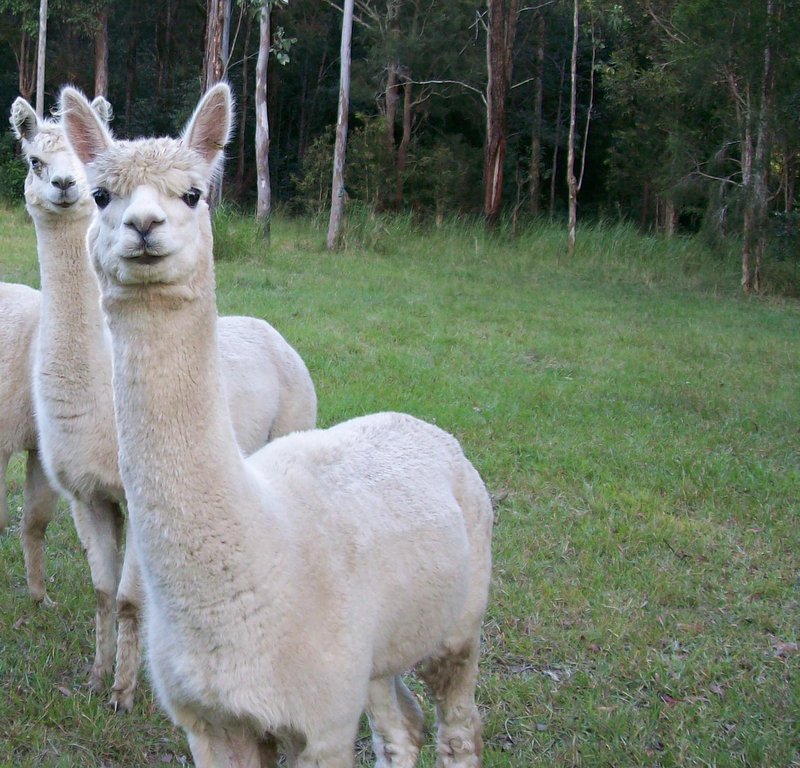
These also caught his eye:
Again, these are well-behaved animals, and they're also very shy- but they're large, heavy animals nonetheless, and so I stayed close by while Darius inspected them from a rather cautious distance. He didn't show any inclination to touch them, once we were close enough for him to see how big they were.
Darius was actually more taken by this:
My bottle-reared sheep provoked a very interesting risk dynamic. You see, she thinks she's a dog. So she had no hesitation in walking right up to Darius looking for food, and he showed immediate awareness of his limits by hiding behind my leg. Right up close, she might not have been as big as the alpacas, but she was as tall as him and clearly far, far bulkier.
I interacted with her for a short time, talking to Darius about her, and he gradually relaxed again- but still wouldn't touch her. You see? He had a natural awareness of some danger to his person- probably a natural reaction to the sheep's size compared to his own.
We often don't need to press the point. If something's lethal, we shouldn't have a child near it. Otherwise, we need to allow our kids a bit more space to assess a risk, before we move in with our own fears. Let their instincts develop naturally.
When Darius had a bit more confidence in the layout of the farm, he did something a bit more risky; he decided to take off to 'find' the alpacas by himself. I let him go off across the clearing, watching from a distance. (Yes, he thought he was ready to go wandering on a strange farm at two and a half. I bit back the natural tendency to stop him.)
Well, not only did he find the alpacas- he found my sheep too, and she ran towards him excitedly. Freak-out! Darius screamed, turned and ran back to me sobbing.
I picked him up, out of reach of my pushy wanna-be-a-dog give-me-food black sheep, and he quickly regained his composure.
So what do we make of that? Was it a terrible thing to do, letting him run off by himself to get a big fright?
I don't think so. There was no
real danger present. Darius tested his limits and found them; end of story. He didn't try to run off by himself again all morning. Surely that's a
good thing. When we let kids take risks, they learn.
I mean, if I'd forbidden him to go off across that paddock by himself, would he have tried to sneak away when I was distracted? There are dams on our property too. There are gullies with water at the bottom. There are long tracks through tall trees and thick bush, where even I've got lost once or twice.
No, no, no. Much better that he found his own limits, while I watched from afar.
At one stage, when I needed to go into the house for a while, I offered Darius some toys. This is what I offered him:
You know, he really wasn't much interested. He played with the bus for a while, rolling it down the ramp, but he found this much more interesting:
Children like
real tools- tools that adults can play with too. They don't always need to have scaled-down, pretend toys.
Yes, it was noisy. I lived. I bit my tongue again when he bashed his hands down, waiting for the moment when he'd find a different way of playing. He did. I just had to be patient, survive the loud bit, and wait for him to discover playing with one finger, playing with two fingers, playing softly.
We played elephant music. We played mouse music.
And soon after this, he wanted to go outside again, where he played with these:
You can see how tiny those flowers are- those are my fingers next to the yellow one. He found all these playthings himself. He examined them, and collected them, and brought them back to the house to play with some more.
Yes, he played with sticks. He chose small ones, in proportion to his body. I didn't stop him. He didn't hurt himself.
Thus we spent a whole morning, a two and a half year old and a lady who had been a total stranger at the start, with only one little moment of tearfulness and not a single whine.
And what does all this tell me, that can be useful to you?
It tells me that children respond to being treated with respect. That child didn't even want to look at me when he arrived. With respectful treatment that acknowledged his space and his needs and his feelings, by the end of the morning he was cuddling me fiercely and not wanting to leave!
It tells me that we have to have more confidence in young children. We don't have to constantly entertain them. We don't have to treat them as though they have no concept whatsoever of risk. We would be well advised to get them outdoors, tape our mouths shut and let them exercise their bodies, entertain themselves and develop their risk assessment skills even further.
It tells me that children don't need to be patronised. We would be well advised to give them access to adult tools now and then- carefully chosen, perhaps, but the real thing- tape our mouths shut and let them explore.
It tells me that the world outdoors is full of children's toys. We would be well advised to tape our wallets shut, stop buying brightly coloured plastic cr*p and stuff we
think our children might want, and let our children
find their own playthings. Toys that are, truly, their own choice.
Children are more capable than we think. And if we allow them the room, if we bite our tongues and give them some respect along with the boundaries, they will constantly surprise us with their ability to entertain themselves.


 Thank you again for your insight and being an amazing source of info for me!