LIKE Aunt Annie on Facebook

LIKE Aunt Annie on Facebook

LIKE Aunt Annie on Facebook

Monday, July 29, 2013

Real tools for kids: dangerous or respectful?

When my son turned seven, a friend of mine gave him a gift that he treasured for many years. Even now, twenty years later, he still has one part of the set in the kitchen drawer in his marital home.

The present was a set of half a dozen Victorinox kitchen knives.

Are you horrified?

Victorinox is the company that makes Swiss army knives. These things are wickedly sharp. I once cut my finger to the bone mishandling one of their pocket knives. Perhaps you're wondering what on earth my friend was thinking, putting such dangerous tools into the hands of such a young child.

But you know, every chef will tell you that the really dangerous knife is the one with the dull edge (how many of you have cut yourself trying to slice a tomato with a blunt knife?). And my friend knew some important facts about my young son:

1. He was already an avid cook.

2. He was not the least bit interested in hurting himself.

You know, I don't think he ever cut himself with those knives- certainly not as a child- and he never left them lying around. They were treated with great care and respect.

He was careful, because he knew they could hurt him badly if he wasn't.

Photo courtesy of Suzanne Axelsson

He was respectful and always put them away in their box- both to keep them sharp, and to keep them where he'd be able to find them. He knew they allowed him to do the creative work in the kitchen that he really wanted to do, and he was prepared to plan ahead to make sure that kept happening. (There was absolute hell to pay some seven or eight years later when one of the set disappeared after a party at our house. I heard about it for weeks.)

Now, let me tell you that this was a child who was disinclined to neatness and putting things away! His room was always absolute chaos- toys from one end to the other, Lego and train track and heaven knows what else all mixed up and all over the floor. But those knives- that was a totally different story. 

These are tools, but they're not real. They wouldn't have had
any respect shown for them from my child, no matter what
age he was. They would have been strewn all over the floor.

A two-year-old might be given the plastic toys in the previous
photo- but here's a two-year-old using a real hammer with
perfect competence. Photo courtesy Suzanne Axelsson.

WHY? Why did my son have a different attitude to the knives?

I suspect that the difference was that he was given a real set of tools. My friend had shown him great respect by trusting him to use those knives carefully and for the intended purpose, and he rose to the occasion.

Also, she knew him well, even though they saw each other rarely. She had managed to create a relationship with him in a very short span of time- and because she understood his interests, she chose the right real tool to give him. She showed real respect for him by doing this. 

So what's my point? What can we learn from this story?

****************

We can learn that respecting children's abilities can create respectful behaviour in children.

We can learn that giving children real tools can be a game-changer, with long-term impact.

We can learn that relationship is the basis of knowing what a child wants to work with, and the key to them doing it safely; remember, play is the work of childhood.

****************

Many adults are frightened by the thought of allowing children to use real tools- particularly those who look after groups of other people's children. 

"What if they hurt themselves?", they say. "I can't have my eye on them every minute. What if they hurt someone else? There are so many children with impulse control issues! It's too dangerous!"

Let me deal with those points, and show you HOW we can make using real tools in the classroom safe. (Parents can easily adapt these methods to use with their own young children.)

1. Children will not set out to hurt themselves, and they are unlikely to hurt anyone else if the preparation is adequate.

If children hurt themselves when using real tools, then the problem is either:

(a) that these children weren't interested in using them the right way (ie, it was the wrong type of tool to give to those children) 

or 

(b) that the preparation by the adult was inadequate.

I am absolutely not recommending that we place razor-sharp knives in the hands of a room full of four-year-olds. However, a four-year-old is completely capable of having a turn of using a sharp knife to cut a birthday cake, for example, if the exercise is preceded by some sensible preparation. (In fact, many much younger children can do this given the right preparation.)

So how do you prepare children to use real tools?

I often start with story books which show a particular tool being used. This is a 'seed' for discussion, and that lets you find out whether the child or children are interested in using that tool. (What child isn't interested in cutting a birthday cake?!)

The next step is to open up a discussion about safety. I might say, "You seem pretty interested in using a sharp knife to cut something. Would you like to try?" (And wait for the response- no prizes for guessing what most 4-year-olds would say!)

And then I might continue,"But sharp knives can be dangerous. Has anyone here ever cut themselves? It hurts, doesn't it!! Do you think we need some safety rules? What rules do you think we should make?"

Remember- children are MUCH better at observing rules if they've had input into making the rules.

I would, of course, provoke responses about matters they hadn't raised. "Do you think it's safe to grab a sharp knife? Do we need a rule about that?" You have to think this whole process through before you start- I'd make my own little list of important points to cover in advance.

And finally, "What shall we do if someone breaks a rule?"

I'd write down the rules and consequences that all the children agreed on. I'd try to write it in positive language- for example, "only hit nails" would be a positive rule for hammers, and "only hold the handle" for knives- but it's actually more important to be faithful to what the kids say. I'd use their words wherever possible.

No, they probably can't read the rules at age four, but in a class situation I'd write them down as a poster and put them up on the wall. That is a literary learning experience! I'd milk it for all it was worth! I'd read it back to them, pointing to the words- their words.

And then, when the real tool came into the room, the groundwork would be done. The rules would be there in black and white, everyone would have had a part in agreeing to them, and we would all know what was going to happen if anyone did anything silly.

Once children have made their own rules by mutual consent, they are wonderful at policing them. You probably won't have to open your mouth.

2. Children with impulse control issues need you to do extra work on relationship and supervision. Then, refer to point 1.

We all know that children with impulse control issues need extra supervision and extra one-to-one attention. The fact is that these children can hurt others with seemingly harmless items- I've seen a child hit a peer with a simple wooden block so hard the peer had to be taken to the hospital for stitches. We have to supervise these children closely all the time. 

That is not an excuse to deny all the other children access to real tools.

But it does mean that we have to think harder about our preparation. 

We may need to find a quiet area, make good eye contact (unless there is an issue with autism) and discuss again with this child, calmly but enthusiastically, what has been decided by the whole class. 

We may need to make a point of asking this particular child (or these children!) what they think of each rule while the class is making them, and we may need to ensure they give an individual response about each consequence. "Do you think that's fair, Brett?" (We need to ask a few kids each time, especially anyone who's not paying close attention!- singling out the child we feel might have a problem with the activity is not constructive.)

INVOLVE THEM. TALK TO THEM. BE POSITIVE.

Having a child with very severe uncontrolled behaviour in our room will usually mean having an additional staff member present for some hours of the day. Those hours are the time to use real tools, with directions for the extra staff member to concentrate solely on helping this child to succeed

(Note: those words are important. If you start with a negative mind set, a negative outcome is likely. Children read and respond to atmosphere.)

You might be surprised at how well a child like this responds to a 'real' activity- children with Aspergers, in particular, are often adept with real tools and might find themselves leading the class rather than feeling isolated!

All children are good at something. For some, using real tools
might be a breakthrough moment which gives them a real sense
of competence. Photo courtesy of Suzanne Axelsson.
And of course you don't have to start with a sharp knife, if that terrifies you out of your wits. You can start with a screwdriver and an old, non-functional piece of electronic equipment- "What do you think is inside this CD player?"- or toys which are past their use-by date. You can start with some soft pieces of wood, some small but REAL hammers and some sharp nails (a plastic comb can be used to hold the nails in place while children learn to strike the nail head; a magnet in an old stocking leg from panty hose can be used to pick up stray nails from the floor afterwards). You can start with any real tool your kids show interest in, as long as you've thought it through and prepared the class.

***************

I'm singing the same song I always sing, aren't I? Respect, relationship, reflection. 
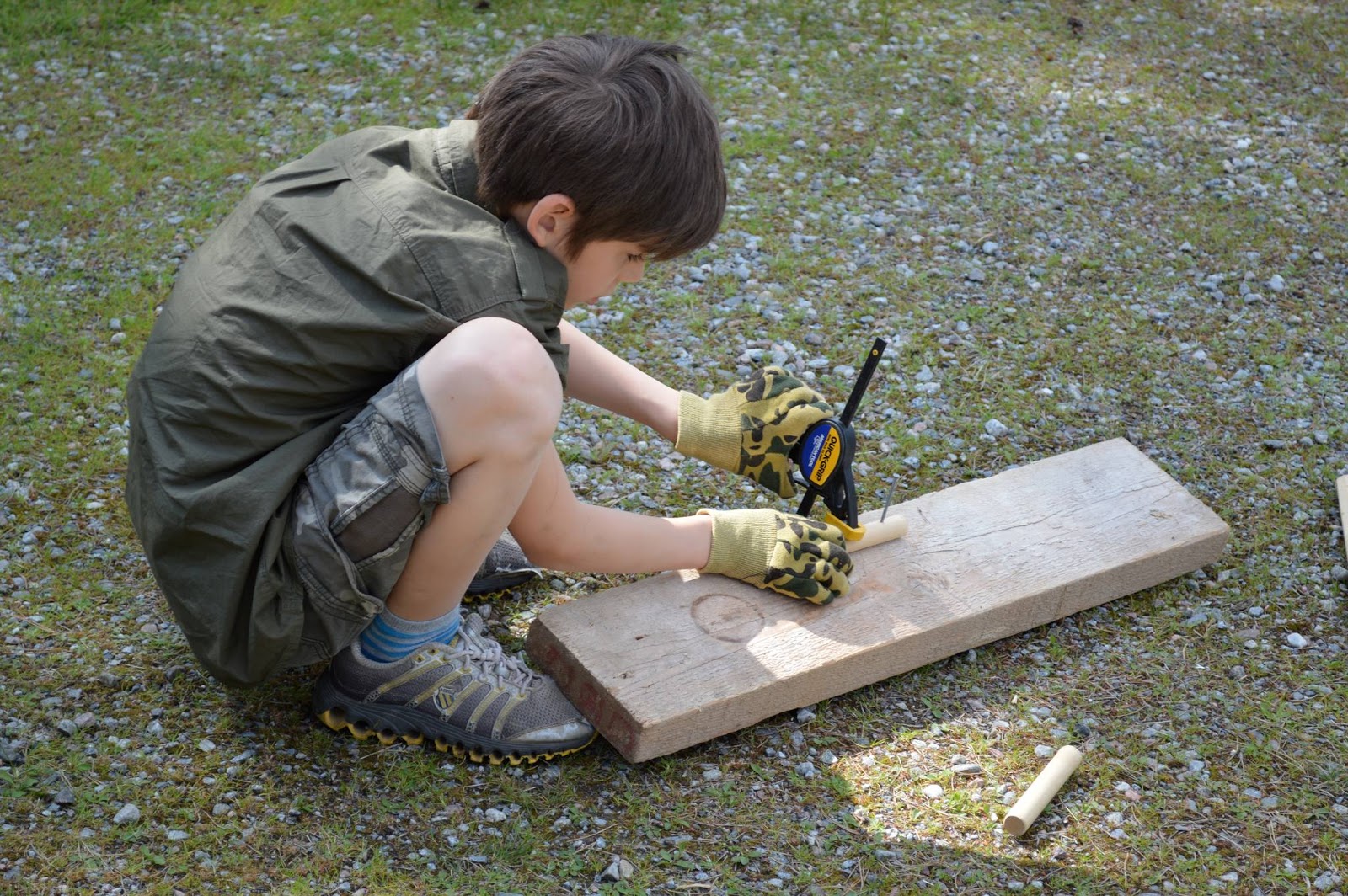
Children are capable beings, and if we respect their capabilities we will very often be amazed by what they can do. Offering them real tools is a way we can show this respect.

Children are people just like us, and they like and need to be part of a healthy, respectful relationship. They like to be involved in decisions that affect them. Involving them in making and keeping safety rules is a way we can enhance this relationship, as well as looking after their welfare and helping them develop risk assessment skills.

Teachers need to reflect if their planned activities are to succeed. Reflect on the children's interests and likely behavioural problems before you start- then plan and prepare, and you'll find that real tools can be a very positive contribution to your educational programme.

Saturday, May 4, 2013

Don't set yourself up for guilt!

There have been a lot of posts and articles coming up in my feed lately about the myth of perfect parenting. 'Mummy guilt', in particular, seems to consume enough of us to warrant special attention in the world of online parenting.

We need to work, so we put our child in care. 

Our child still hits us, despite our gentle parenting. 

We couldn't breastfeed, 

or our child will only eat white bread and peanut butter, 

or we didn't parent our first child as well as this, because we just didn't know...

Those articles and blog posts will tell you this is normal. They'll tell you there's no reason to feel guilty. They'll tell you we all fail sometimes.

But reading an article which tells us not to feel guilty really isn't enough, is it? Failing, and feeling bad about it, does seem to be part of the parenting journey for all of us (and if you're telling me that either you've never failed or you've never felt bad about it, then you're lying to both of us). But getting past that sinking feeling when we mess up is something else entirely.

So this morning, I started to ask myself if there's any way I can help parents to avoid setting themselves up for failure and guilt, and I came to an 'aha' moment. It won't fix every bad feeling. But it can fix rather a lot of them.

This much life has taught me:

When things go wrong, we have probably contributed to that ourselves somehow. But the answer isn't guilt- the answer is reflection. 

The answer is thinking about what happened, and why, so we can avoid walking the same path next time.

Guilt is destructive.

Reflection is constructive.

How much time do we spend reflecting on where we came from- on our own experience of being parented- and on how our expectations about parenting have been hard-wired by our environment, before we have children ourselves?

Probably very little, unless we've been in therapy. Mostly, we walk blind into parenthood with some fantasy of being the perfect Earth Mother who does it all the natural way, or being the mother with perfect, well-behaved, bright children who never put a foot wrong, or the working mother who has it all because we chose the right childcare provider and school before the kids were even born...

Life has a way of making fun of our plans, doesn't it?

How about I give you an example of a hard-wired parenting mistake that stems from the parent's own childhood? Examples always bring philosophical ideas to life.

The failure

Let me tell you about a little two-year-old I know who refused to eat. He would take forever over his meals. His mother was trying everything! She was offering him everything, in the hope that he'd eat something. The table was full of child-friendly food, and he was having none of it- both literally and figuratively.

Did she feel like she was failing? My word she did, even though she was trying her heart out.

Did she feel guilty? Absolutely!

The reflection

When I talked to the mother about her childhood, it was clear that she'd been parented by an anxious and fairly rigid mother. She'd never been given choices at all as a child. Everything to do with eating, in particular, had been both contradictory and dictatorial. "You need to go on a diet!" might well be followed by "You need more food than that!"

This mum was determined to do better! Her child would have choices about food. Then he would eat what he wanted and needed, rather than learning the problems she herself had experienced all her life with food and body weight.

But it wasn't working. It should be working! What was she doing wrong? She was so worried!

The solution

Sometimes when you make a parenting decision which is a reaction against the way you were parented, your judgment can be clouded by the emotions involved. Some of her instincts were perfect- it's wonderful that she was trusting her child to know what he wanted to eat, and to make the choices for himself.

But her first problem issue was that her son was only two- and, forgetting or maybe not understanding that a two-year-old is very easily overwhelmed, she was unconsciously giving him too much choice. In fact, she'd transferred to him almost the same level of choice she would give to herself as an adult. Half the pantry was out on that table.

When I suggested that she offer a maximum of two choices to her son, the transformation was instantaneous- he would reach out to the one he wanted with little or no hesitation.

The other factor at play was that, like her own mother before her, this mum had learned to be anxious about anything to do with eating. And just like her, her son was a very sensitive child to emotions (most young children are, in fact). I suggested she step back, having given him that initial choice, and busy herself with something else. No hovering!

Again, the result was magical. Mealtimes became quicker, easier and guilt-free. When you take the emotion out of mealtimes, children can find their own body sensations of emptiness/fullness and respond to them without worrying about what will please or upset their parent and reacting to that.

So- do you see how this mum had accidentally set herself up for failure and guilt? Overreaction to your own childhood experiences can cause you to make less-than-ideal parenting decisions.

There are many, many things from our own childhoods that we might react against. A parent who comes from a home where there was constant yelling and violence, for example, may determine to become a 'peaceful parent' (please do!!), and then wonder why their child is acting out and making them want to fall back on their own parents' methods. They might start to spank, and plead online for help before they become their own parents all over again, despite their best efforts.

I've seen that time and time again.

Often the answer is that this parent has been giving boundaries without firmness in their tone, or making directions into questions, or giving an explanation of the reason for the direction without giving a clear direction at all. Perhaps they've been saying, in a tentative tone, "Pick up your toys now, okay?" and "It hurts when you hit mummy", instead of saying firmly (but quietly and politely) "Please pick up your toys now so we can go to the park" (and not going to the park if it doesn't happen) and "I won't let you hit" (and physically stopping the child from doing so).

It is hard for the now-grown, once-cowed child to learn and use a firm tone of voice as a parent, and to ask or state their requirements very firmly and directly. Don't think I'm telling you that reflection immediately fixes everything! I'm not! New habits must sometimes be learned, and that is always difficult.

But learning a new habit is much more constructive than sitting there feeling guilty because you failed, yes?

Overreaction isn't the only faulty response to our own parenting, either. Sometimes our respect and love for our parents blinds us to the fact that they, too, made mistakes. Of course they did. If there's no such thing as the perfect parent, then we didn't have one either.

That is a very hard pill for some of us to swallow.

I believed for a very long time that my mother was the perfect mother- till long after she'd died, in fact. She was always respectful to me, she always explained things, she supported my interests and I always felt loved.

It wasn't until my son was quite grown up that I realised that I'd copied one of her failures to the letter.

You see, I was never expected to do chores or clean up after myself. I was expected to do my homework, practise the piano, be polite to others and fastidious in my personal care, and entertain myself most of the time- all of which I duly did. (With the possible exception of the piano practice- but that's another story.) I copied those ground rules to the letter with my son.

What did I get for that? For myself, I got peculiar looks from my girlfriends' parents when I was invited to dinner and never offered to help wash up. I nearly got thrown out of my first share house for never washing my own dishes. I learned about chores the hard way, and it was NOT fun.

I never connected the dots about that before I had my own child. I just copied what my mother had done. And needless to say, my son has had 'tidiness issues' too. I won't go into too many details, but let's just say that I've had cause to regret not making daily chores part of the learning experience when he was young.

It never occurred to me that my own parent might have been wrong. If you'd dared to say so, I would have challenged you with great anger.

I see this same anger when I try to help parents who, for example, can't understand why their adolescent has become a stranger and won't  obey them. Their child is too big to spank now- what can they do? They've escalated punishments till there's nowhere to go.

It's nothing to do with the spankings, they say crossly. I was spanked myself as a child, and it never did me any harm!

Of course, it's too late to tell them how flawed their thinking is by then. Challenge the idea of spanking, and you challenge their respect for their own parents.

And of course, if you try to warn a spanking parent of what the consequences will be before their child hits adolescence... they won't believe you. They probably won't reflect on how they themselves felt as adolescents, how they rebelled, how little they told their parents about their lives as they 'broke away' and became independent for fear of being punished.

So copying your own parenting can be as fraught with danger as overreacting to it. It takes a lot of reflection to find that middle line between making the same mistakes and making the opposite mistakes!

And here I'm going to draw in another thread that's turned up in my Facebook feed lately: the cult of busy-ness. If you're too busy to spend quiet time reflecting on how you were parented, and what the pitfalls might be, then maybe it's time you dropped something.

Reflection is important. Of course it's more important than a new car, or a pair of shoes, or even than a house in a posh suburb- yet some parents get obsessed with income at the expense of their children, and then suffer the pangs of parent-guilt when something goes badly wrong.

Believe it or not, it's also more important than being with your small children every second of every day. You MUST have quiet time to think if you're going to try to avoid that sense of guilt and failure, and you can't think and reflect with a toddler pulling at your jeans and a baby crying.

To avoid parent-guilt, you need to prioritise some time-outs for YOU, where you can either be alone to mull over the past, chat with friends who are in a similar boat or even see a therapist if your childhood was a traumatic one.

Understanding why is the first step to healing failure and guilt. And you will never understand why if you don't give yourself the time to reflect. Please, take that important first step!


Wednesday, April 3, 2013

I was looking the other way

Tonight I am in a very sober mood. I am reflecting on failure tonight. It's a particular type of failure that could happen to any one of us, all while we believe we are doing our very best.

Many years ago I had the privilege of teaching music in an extremely high-quality private school. I dealt with many very talented young musicians every day, and their dilemmas were many and varied- if, for the most part, very much 'First World
Problems'.

I dealt with many adolescents who were crushed by the constant competition, shoring up their egos and their abilities and their confidence until they were in some sort of shape to pass their exams. How many hours I spent trying to defuse performance nerves!

I dealt with others whose shy talents needed my encouragement and time to flourish. I gave them that time with enthusiasm, and took great personal pride in their achievements under my watchful eye.

I dealt with many, many 'tiger mums'. They were, universally, a nightmare. I admit it: they put me off their own daughters. They prejudiced me against their offspring. And some of those young musicians didn't even need their tiger mums to help them- they did the pushing and the competing all by themselves.

I found that repellant.

In my defence, I was young. But I know I gave less of my time and patience to those who pushed.

I was too busy looking the other way. I thought there were others who needed me more, and I justified my decisions about how to spend my time easily. It seemed right to give my attention where it was needed most.

Some twenty years on from those years, today I was told that one of those young and (if truth be told) rather pushy prodigies- an extraordinarily talented young woman who seemed bound for concert hall success under her own steam- was dead. I know few details- nor, given my past attitude, do I deserve to- other than that it seems she killed herself.

And I sit here shocked to the core, because it never would have occurred to me in a million years that such a thing could happen to someone who seemed to have it all together from such an early age.

Now, I have no illusions of responsibility for what happened to this young woman. Mental health issues are terribly complex, and well beyond my field of expertise; perhaps the demons were circling back then, perhaps they were not. But the thought torments me that perhaps, by some miracle, my engagement with this girl way back then might have made a difference.

I am so aware of my failure all those years ago: I didn't even try to engage with that child as a human being. I didn't give her anything of myself, really, because I thought she had what she needed already.

I am so terribly aware that I made an assumption based on appearances alone. Because that young girl appeared to need me so much less than many other girls, I paid her little attention.

I thought she was okay.

Do you see where I'm heading?

I am so much older now, and so much more experienced. I've seen a lot of different scenarios, within families and within educational settings, where some children have appeared to have much greater needs than others and so have been given the lion's share of attention, resources, time and effort. I've noticed, increasingly, how much grease the squeaky wheel gets, and how easy it is to just assume about children who seem to be coping just fine.

I'm not saying we shouldn't invest vast time, effort and resources in those who need it. No way. Of course not.

But I do want to say this to you: every so often, look the other way.

A child with any sort of special need does need your extra help. Of course they do. And give that help you must, and you are probably completely exhausted from trying to provide as much help as you can. But every so often it's important to stop looking at that particular child, and look the other way.

One terrible true story: a parent who was so busy brilliantly looking after the rights and needs of one of their children, who had a special need, that they didn't notice that another of their children was being sexually abused.

Another terrible true story: the child whose academic success blinded her parents to the fact that she simply wasn't eating. At all. They were looking at only one part of their child, until she ended up in hospital on a drip.

Try not to be blinded by the obvious, as I so often was. Take the time to engage with all your children in a meaningful way, not just with the squeakiest wheel.

I don't want you to find yourself sitting many years from now, as shocked as I am, only just seeing in brilliant technicolor that all children have a need for our attention- whether that need screams in our ear, or just whispers a dangerous script inside a child's head until it's far too late to save them.


Friday, March 29, 2013

Guiding children's behaviour using calm words alone

Have you noticed that children rarely respond to pushing when you're trying to change their behaviour?

We'd love the playroom to look like
this... but more often that bin is
emptied all over the floor, right?
They don't sweetly tidy their room because you yelled at them to pick up their Legos off the floor. (Well, not unless you've got that child so cowed by fear that they're going to grow into a bullied child or a battered wife some day.)

They don't stop playing those games with pretend guns because you banned them. (They just play them round the corner, where you can't see them.)

They don't immediately stop having an embarrassing tantrum in the supermarket aisle because you gave them a slap on the leg or the bottom. (If anything, they yell louder.)

So where do we go instead?

For mine, the answer is shining a light with your words. Try to think of yourself as the sun. If you can cast some light on the situation and show your child where the shadows are, you stand a chance that your child can feel a sense of personal control of the situation and make better choices.

Now, I know that's counter-intuitive for some of you! You may be feeling that your child has too much control already, or is just totally out of control! LET GO OF THAT. What you are trying to do is let your child have room to learn better choices, and they can't do that with a policeman making and enforcing the rules for them all the time. 

Let me be clear here: there ARE times when you need to call a halt and be a policeman, such as when another child or an animal is getting hurt. That's an "I won't let you do that", physical-prevention moment, before you shine your light. 

I'm talking about those moments when you're tempted to be a moralist, when a certain behaviour seems socially unacceptable to you, when you're trying to nudge your child onto a better path. That's the moment to stop yourself in your tracks and, instead of talking AT your child, turn on the light.

The magic word here is NARRATION. Narration just means saying exactly what you see, without interpretation or judgment. You describe the scene before you.

Let's say a child is constantly pushing in to get a turn on the slippery dip. Instead of a lecture, deliver a description.

"I see Nathan trying to push in front of Xavier. Xavier's face looks angry to me. Xavier has been waiting for his turn behind Zac, not behind Nathan."

And let them work it out. Give the power back to the children. Xavier will feel acknowledged; he may find the strength to speak up directly to Nathan, instead of pushing back. Nathan himself may wake up from his desire to have another go now and notice the other child's disapproval- far more powerful to him than yours! Then he has the choice to change without being told.

You'd be amazed how often this works.

Here's another example. A two-year-old, denied a third biscuit or a certain item off the supermarket shelf, throws herself on the floor and screams incoherently. Instead of reacting, describe what you see. 

You might have to put your face down next to hers first, mind you, and describe your own difficulty: "I can't understand your words when you yell and cry. Can you take some big breaths and then tell me what you want?"

Once you use emotions' names
often enough, children start
to join the dots and can put
themselves into a recovery
space if you provide it. This
is an 'angry space'.
Then you can describe what you see. "I can see that it makes you very angry, or maybe very sad, when I say no. Your angry, sad feelings are making you bang your fists and kick the floor because they are too big for your body to hold them inside. Will it help if I help you hold those big feelings? I have nice long arms if you'd like to put some of your big feelings inside them."
And this is a 'sad' recovery area.


You'd be amazed how often a sobbing child ends up in your lap. Though of course, sometimes you need to be patient and wait till the child is ready to make that choice.

Narration works from birth to ease over difficult moments. The Magda Gerber approach as advocated by Janet Lansbury - Elevating Childcare and Lisa Sunbury - Regarding Baby, for example, show you how to use narration to calm and prepare a child who hates nappy / diaper changes by describing what you're going to do before you do it. 

"I see you have a wet nappy. Now I'm going to pick you up so we can go change it."

"I'm going to take it off now- it must be uncomfortable. I see you like to have a kick when your nappy is off- that's okay! You have fun there while I pull out the wipes."

And so on. Pop on over for some great ideas and scripts for the squirmy baby.

And what about those Legos on the floor? Damn, they hurt to walk on! Narrate, narrate, narrate.

"I see that the Legos are covering almost the whole floor. You are obviously having a lot of fun with them. But I have a bit of a frown on my face because I am worried about how I will get to your bed to kiss you good night without hurting my feet badly. I see that the box they live in is just over there."

And walk away! Leave your child the opportunity for agency and free choice of his/her behaviour. That is how they learn good choices

Stop pushing. It doesn't work. It encourages stubbornness, reactiveness and pushing back.

Start describing. It works. It encourages cooperation, verbal instead of physical interaction and emotional intelligence.

And once you see the results, you'll rarely go back... except in those moments when you really, really need a break yourself. Narrate that to yourself and your children, too. Not just advice for parents- it works for childcare workers too! I used to do it often in my preschool room!

"I am feeling very upset right now, so I am taking a little time out till I can feel calm again."

And I would breathe deeply. Often the children who had created the meltdown would take the hint, and start breathing along with me till the whole situation calmed down naturally.

That is a fine lesson to model!


Friday, February 15, 2013

Plastic-fantastic-free gift shopping for kids

Last time I blogged, I was on my high horse about ridding your house of the plastic fantastic and encouraging your kids to play independently. You can find that post here if you missed it.

Are we having fun yet?...
But hey, this is the real world! Kids have birthdays, Christmas (or your own personal gift-giving festival day, according to your faith) comes around...

....and that's when stressed-out, busy mums and dads get overwhelmed. Oh *expletive*, the birthday party's tomorrow... or this afternoon, heaven help me!... (Well do I remember that awful moment, from my days as a working mum with an equally tired child in tow!!)

That's the moment when they grab the first vaguely appropriate piece of junk they can find on the supermarket or toy shop shelves. Or, in many cases, inappropriate piece of junk.

So I thought it would be only fair, after that last post of mine, to talk about some possibilities for junk-free present shopping.

Presents that encourage outdoor play

A toy that encourages kids to get outside, run around, use their muscles and develop hand-eye, gross motor or fine motor co-ordination is almost never a mistake. Do make a call and check with parents that some of these are appropriate for their family culture and environment, though.

Balls of any shape and size are always going over fences or being punctured by the dog and needing replacement. Check what ball games the child enjoys.

Game sets- cricket, boules, T-ball, badminton, volleyball, indoor 'soft' alley bowling for families with a hallway, even lawn bowls- encourage families to interact.

Blow-up punching bags- the sort you put sand or water in the bottom of, so they bounce up again- can be a hoot, and they help very active or frustrated kids channel aggression away from hitting other children or throwing things. (These can be particularly helpful with children who are enmeshed in a family crisis such as divorce or illness- things that are out of the child's control.)

Skipping ropes, especially longer ones that encourage children to team up and take turns, seem to be unusual enough these days to spark up children's curiosity. (NB: Always supervise skipping games to ensure ropes don't end up being used inappropriately- actively teach safety considerations.)

Real tools for gardening, including seeds and seedlings of edible plants or beautiful flowers, can encourage good eating habits and a sense of beauty, as well as being great fun and giving the child a sense of 'ownership' of the outdoors.

Presents that encourage creativity

There are two main 'big hints' I want to give you here.

One: OPEN-ENDED toys encourage creativity. The less defined the purpose of the present is, the more it encourages creative thought.

Two: CHILDREN LOVE REAL TOOLS. Never buy plastic fantastic when you could buy the real thing instead.

Small open-ended building kits, such as Legos (avoid the gender specific ones, please!) which start as an exercise in following instructions and then eventually become something other than what's on the box, make great gifts.

Balsa wood dinosaur, insect and aeroplane kits can fit in with a child's interests, as can plastic model boats and planes to build and paint. The 'creative' part is not so much in the construction- that's more a fine motor skill builder and a lesson in multi-step direction following- as in the decoration, so supply paints as well if they're not part of the kit.

Don't assume that a girl won't enjoy constructing something like this, either. I used to be horribly jealous of all the building kits given to my brother.

Craft kits- jewellery making, gift card making, anything at all that provides the materials and tools but preferably doesn't give a blueprint for exactly what the end product should look like- can entrance a child for hours.

Again, don't assume that a boy won't enjoy that sort of present.

An inexpensive digital camera - and I'm not talking about one slathered with Disney princesses or Spiderman- is a wonderful present for a child. I've found this a particularly useful gift for children with special needs, such as autism. Looking through a camera lens is often far less threatening than looking a person in the eye.

Cookware, and I'm talking about real tools. Children adore having their own real stuff for baking. A wise friend of mine, knowing that my boy LOVED cooking, gave him a set of small Victorinox kitchen knives before he was even in his teens. I don't remember him ever cutting himself, and he treasured them with a passion- I suspect he still does today. At times when she had less money to throw around, she'd contribute smaller items like a garlic peeler or mortar and pestle, which were received with almost equal joy.

The wild animal prints were a big hit.
From the op shop!
Dress-ups don't have to be purchased from a toy shop. Go to an op shop (thrift shop), or check out your own wardrobe for fun items you don't use any more. My mother's cousin's old cocktail dress was a gift I enjoyed for many, many years, and you KNOW how kids love 'real' handbags and shoes.

Hide-outs such as tents, or do-it-yourself kits made from op shop-purchased lace curtains with big bulldog clips or string ties to secure them to trees or tables or doorknobs, can provide hours of fantasy play.

How the kids loved Mr Crocodile...
Puppets are something that every child needs to own. Sometimes a puppet will tell you something that the child can't let out through their own lips... and sometimes it is better to act out a conflict with a puppet than to put a child 'on the spot'. (NB: I have purchased quite a few mint condition puppets from op shops, much more cheaply than the new price!)

Add-ons for existing open-ended collections can extend play in new directions. An extra few pieces of wooden Brio train set were always welcome gifts for my son.

Presents that encourage intellectual growth

(NB: With all these presents, it's a good idea to be sure not just of the target child's chronological age but of their mental age. My gifted child was doing jigsaws, playing board games and reading books many years above the suggested appropriate age level, so know your child- or purchase a voucher instead.)

Books are another sure-fire, non-junk present. Always subtly take along the receipt in your bag, in case the book is a double-up and needs to be changed- or get a book voucher instead, and let the shopping trip be part of the extended joy.

Jigsaws are another winner for kids who enjoy them.

Strategy board games and card games can be another big hit with slightly older children. You can get simple card games for younger children too, like Happy Families or Go Fish. These have the advantage of encouraging socialisation and family time.

How-to guides are another present that can centre on a child's interests- how to make a paper plane, fold origami, create tole work, play chess, do bush crafts such as making an outdoor shelter from branches, etc etc... these can be treasured parts of a child's library for many years.

A piggy bank with a donation of lots of your loose change inside encourages delayed gratification and teaches great life skills, as well as encouraging maths skills as child tries to work out how much he/she has been given and what they can spend it on.

Personal furnishings and accessories

(Hint: steer clear of branded character goods, eg Disney princesses and action heroes. That 'closes' the child's imagination regarding the function of the item and also affects the child's moods and behaviour when using that item.)

A special oversized cushion can be both comforting and fun. Small cushions in appealing colours and designs are also very popular, and can be used for dolls as well as kids.

A personal chair- whether a beanbag (avoid in houses with children under 3 years), beach chair with drink holder or a child-sized foam lounge- can be treasured for years and used for dolls and teddies when the child grows out of it.

Even a satin sheet from the op shop...
can be the sea! Or a tent... or... And the
rainbow scrap was much in demand.
Soft, cuddly, child-sized throws and material scraps of various sizes- I just visit the remnants bin at Spotlight and hem them up on my sewing machine- can provide quilts and tents for dolls, scenery for imaginative play (the sea, the sand, the rocks, the flower garden), cuddlies for nap time, symbols for moods (I had a volcanic red we used for anger, a sunny yellow for joy, and a cool blue for sadness in my preschool room, and the kids really got into it) or just a beloved mat for curling up on and dreaming. A whole rainbow of coloured, textured scraps can really excite a creatively-minded child.

Outings, interest and special need presents

Tickets for the child to accompany you or one of his parents to a live show, the zoo or another fun venue are lovely presents if you can afford them, and can provide weeks of excited conversation afterwards.

Camel ride, anyone?
A special outing with you, the giver, and your child to a cafe or restaurant, or to an outdoor  'adventure' of some kind can be both relieving for the parents and a memorable experience for the child.

An iTunes gift card has never, to my knowledge, been rejected by a teenager. It's a gift that keeps on giving and it doesn't matter if you double up or give the same thing many years in a row. Music is an important part of a teenager's growing sense of identity and can be very comforting for a confused, angry or sad child.

It doesn't have to be a puppy- sometimes
a fully grown animal is a better choice.
And go to pounds and refuges, not pet
shops please!
A companion animal can be a saving grace for a child who is having trouble with friendships.

NEVER BUY A CHILD A PET WITHOUT CONSULTING THE PARENTS. But do consider how an animal to care for, to love and be loved by, can transform a child's life.

**********************

Well, that's all very well when you're doing the buying. But how do we prevent well-meaning friends and relatives from cluttering our own homes up with the plastic fantastic twice a year?

Avoidance strategies

Think ahead!

When you write the invitations for the birthday party, consider inserting a short but subtly worded note which includes thoughtful gift suggestions and plenty of flexibility in price and gift style. Something like this.

"Here are some quick-fire gift ideas for (name) to help you avoid that ghastly gift-shopping experience!

"Children's book store voucher
iTunes card- (name) would love to expand his Wiggles music collection!
Piggy bank with 'donation' of your loose change inside
Anything to encourage outdoor play, craft or building
Interests: he enjoys cooking with real tools and cookbooks
Invitation to join you at a cafe, restaurant or other child-friendly outing (please, no fast food)
Tickets to a sporting event, music concert or movie (G-rated only please)
If you'd really like to buy (name) a toy, he currently collects Matchbox cars."

And there's no reason in the world that you can't prime people at Christmas, too. Discuss with your family and any Christmas Day guests what gifts would be most helpful and appropriate for your children- or even go gift-free for a year. Make it easy on people- perhaps you could have a year where everyone from outside the immediate family buys your children book vouchers only?

NB: discuss your change of gift-receiving plan with your children before the big day! We don't want any meltdowns! A mega-shopping excursion to the bookshop can be presented as something exciting to look forward to- you could even take the kids on a preselection trip, where they can look for what they'd like to purchase if they get enough vouchers.

You may find that having these open discussions well before the gift buying frenzy takes place helps to open up your own relationships with family members too, and makes that special day less stressful for everyone.

Be honest, but tactful, when talking to gift givers. Don't refer to failed presents from previous years- instead refer to what your child was really excited by and used over and over again.

Remind, gently, about any house rules (eg no junk/allergy producing food, no character-branded goods, no sexism, no screens, no PVC plastics, nothing that needs batteries, or whatever is your own particular bete noir). Always explain why you have decided that, with your emphasis on how it affects the child's behaviour or wellbeing (nobody really wants to damage your child, do they?).

Try not to go over the top- keep it short and sweet.

MINIMISE PREACHING YOUR PHILOSOPHY. "We believe" statements sound judgmental and patronising, and can inspire people to get back at you for making them feel bad by ignoring what you want! Concentrate on explaining your child's needs.

******************

Well, that's about enough from me. What can you add to my list? What are some great, non-junky presents that your kids have just loved and that haven't driven you crazy?

Sunday, February 3, 2013

15 tips for toy-free play

A toy-free play scenario

Look, Mum- no toys! 
I wasn't feeling at all well when I walked into Centrelink. I was hoping that my paperwork would be processed quickly and I could get out of there and go home.

It wasn't to be, of course. It was lunchtime; the queues were long and the staffing was short. I sat down, resigned to a lengthy wait.

And then the entertainment started.

The two indigenous children were completely focussed on their game. The four-year-old stood right in the beam of the electronic door opener, oblivious to the clunk-clunk of the door opening and shutting behind him. He clasped his hands, raised them over his head, swung them over his shoulder and waited.

At the opposite end of the carpet, right in front of me, the two-year-old knew his role. He clapped his cupped hands together, drew his arm back. Delivered.

WHACK! The four-year-old's arms flew forwards, and he took off around the foyer, long hair flying. Skittered behind a pole and slid his feet forwards, landed triumphantly on his backside.

Meanwhile the two-year-old was racing forwards, arms in the air. His silent grin said it all. CAUGHT IT! You're OUT!

The two swapped roles then, and the impromptu baseball game continued. There was not a bat or a ball or a base in sight. The children were completely absorbed, completely silent other than the sound of their feet padding along the carpet.

Nobody told them to stop. They weren't bothering anyone, even when careering wildly round their imaginary diamond. I watched, hypnotised by their complete focus.

Their mother, waiting her turn at the counter in another corner, hardly glanced their way. She didn't feel a need to hand her children a phone or an iPad to entertain them. She didn't give them a colourful, branded toy to try to keep them quiet. She trusted them to entertain themselves, and they did.

They entertained me, too. And I applauded that mother silently for her good sense, and for her ability to trust her children to know how to play.

When the game of baseball finally ended, Mum handed one of them a torn envelope from the counter. That's all. The two of them explored that for some time, opening it out along its seams and trying to put it back together.

After a while, the younger child approached me and handed me the envelope. (Yes, naturally I'd been talking to them both as they played their game- I can't help myself!)

"Can you fold it up?" asked the older.

I extracted a little more information about what they wanted before folding the paper back into its envelope shape. That spurred a short game of 'Postman', with the letter being delivered, opened and 'read' several times.

We were still waiting. The queue inched forward.

When 'Postman' lost its charms, the children started trying to project the folded envelope through the air. My partner, chuckling beside me, couldn't help himself.

"Do you want a jet?" he asked, and when they nodded, quickly folded the paper into plane shape with a quick tutorial on how to throw it.

That absorbed the two children for another five minutes, until my name was called.

I'd forgotten I was feeling sick; I was grinning my head off. Those children had waited in a completely non-child-friendly environment for the best part of half an hour with absolutely no toys and hardly any adult input, and they'd entertained themselves completely happily.

Did they climb on the furniture? Yes, occasionally, to throw their jets from higher up. Nobody turned a hair. It wasn't a national disaster.

Did they fight? Yes, once, over whose turn it was to post the letter. Hair was pulled. There was a single yelp.

"Stop fighting," said Mum, and they did.

"Whose turn is it?" I asked when they looked to me, and they immediately sorted it out themselves.

Those two children knew how to play. They knew how to play regardless of where they were and what resources they had. There was not a single whine in half an hour.

Do you wish your kids could do that?

*************************

Before Happy Meals, didn't kids
collect shells?
So let's just recap this. Here we are in the welfare centre of town, watching two small children from financially disadvantaged backgrounds entertaining themselves happily and independently, without toys, for half an hour while their mother waits to be served.

SO. What was going right here, and how come we so often get it wrong when it comes to children's play? Why do we believe that children must be entertained all the time, lest they become some sort of nuisance? Why are we, who are so much better off than this impoverished mum, so quick to hand over the iPhone or to fill children's hands with cookies or toys when we have to wait in line?

Why are our houses full of plastic junk?

Why can't we trust our children to find a way to play without a pile of plastic junk?

What can we change, to help our children to play as independently as the two children in Centrelink?

***************************

Aunt Annie's hints to encourage toy-free, independent play

The first thing I'd note about what I saw in Centrelink is that at some stage in these two children's lives, an adult has taken the time to play a ball game with them and teach them the rules. Someone has run around outdoors with these kids and inculcated a love of a particular game.

I have no idea what the rules were.
But all we needed was a ball, and a
stick of bamboo.
1. Get outdoors with your kids. 
If your kids are getting stroppy, take them outdoors and run around with them. You will ALL feel better. Go to the park, the beach, into the woods- anywhere outdoors where they have room to move and have their own space. You'll probably find them inventing their own toy-free games in no time.

2. Spend time with them. 
Be present when you play with your kids. Put the phone away. Talk to them. Ask them questions. Play toy-free games like hide and seek, chasings, What's The Time, Mr Wolf? or building cushion forts.

3. Play games with them, including games with rules. 
Don't assume kids are 'too young' for simple games or sports with rules. Start with the basics, and be flexible.

4. Be enthusiastic, and don't take things too seriously. 
Remember it's a game! Have fun. It doesn't matter who wins.

Build and decorate a sand castle
5. Build their play vocabulary by doing new things with them.
What toy-free games did you play as a child? Do that with your kids. Go climb a tree, or go fishing, or dig holes in the garden.

The second thing I'd note is that these children didn't have an expectation of being entertained AND their mother trusted them to play by themselves. Right from the start, they made their own fun. They found something to do, using their vivid imaginations. That game of baseball was real to them- you could see it in their eyes.

6. Stop entertaining your children.
Right from birth, you can stop worrying about keeping your child entertained. JUST STOP IT. Even a baby has plenty to occupy its mind, learning how its hands and feet work. The correct answer to "I'm bored" is "Are you?". Full stop. Don't make suggestions!

7. Trust them to find something to do.
Honestly, if you stop filling the gaps, they WILL find something to do. They need to explore the inside of their heads till they find something that interests them.

8. Provide opportunities, not answers.
If you listen and allow them to do what they want in their play if humanly possible, you are halfway there. Ask questions till you find out what they need to help them play; provide that opportunity if you can, as long as it doesn't involve a trip to the shops!

Acting out songs- fun, and toy-free.
9. Encourage imagination.
Be playful. Read books together, and refer to ideas out of those books. Pretend to be characters with them. Act out scenarios with them. Let them dress up in your old clothes.

10. Allow yourself to be silent.
Sometimes the best help you can give children who want to play is to butt out and be quiet. If in doubt, say nothing and WAIT.

The third thing I'd note is that there wasn't a toy in sight. The only 'plaything' offered to these kids was a torn envelope; otherwise they used their imaginations and, occasionally, the furniture.

See that? That's a TOY. It didn't
cost a cent. But kids will play
with found items for hours.
11. Stop buying toys- especially brightly coloured, character-themed and gender-specific ones.
I have seen miracles happen when I took children away from all the plastic fantastic and let them loose outdoors instead, with few or no toys. End the clutter. Take a trip to the op shop or the tip. Stop consuming.

(Note: since writing this post, I've added another with tips about how to stop buying this garbage and having it bought for your kids- you can find it HERE.)


Children love to play with real tools.

12. Offer household resources instead of toys.
Pots and pans and lids and wooden spoons are toys. (No, you don't need to buy a toddler a drum kit.) Writing equipment is a toy. A chair can be a toy. Think creatively, and don't be so precious about your household stuff. Kids love to play with real tools- you are SURROUNDED by appropriate toys.

That is not a sheet. That is the ocean.
13. Be flexible about how your kids use the furniture and household goods.
While your kids are young is no time to be auditioning for a House and Garden photo shoot. Let them make forts out of the cushions and play hide-and-seek under the table. Put away the precious stuff, and relax already!

Old mattress, repurposed as a gym mat


14. Recycle household rubbish as toys, including furniture and technological equipment.
An old CD player or phone and a screwdriver can keep an older child entertained for hours. Ask your kids if they'd like to play with things before you throw them out- you might be surprised. I'll say it again... children love to play with real tools and real household items.

A child who shows interest in making sounds
on the piano? Offer a step up.
15. Offer your support to play, rather than directing or ignoring it- help kids go to the next level of understanding.
If you see your kids' play going round and round in circles- if frustration is setting in- that's the time to step in and quietly offer a step up to the next level (like showing them how to make or throw a paper plane). Then quietly step back again while they master the skill. Offer yourself, not STUFF!

Well, there you are. Are you ready to declutter your house and trust your children to entertain themselves? Go on- try it!


Friday, December 28, 2012

Power, parenting and 'solving' gun violence

There has been much said and written about solutions to the spate of school shooting tragedies in the USA. "Better gun laws," cries one faction. "More guns in schools," cries another. "Better mental health care," cries a third. And so on.

When a young man goes berserk with a firearm and kills innocent children, I guess it's natural to look for a single reason so we can feel comfortable that we understand what happened. It's natural to seek a simple solution so we can focus blame where we think it's due, tell someone how to fix it, and move on.

Unfortunately, we humans have a tendency to focus our attention on whatever 'answer' fits best with our world view. That much is predictable.

So, for example, the recreational shooters will call for armed guards in schools, while the pacifists call for stricter gun control. The parents of the mentally ill will see terrifying parallels with their own situation, and call for more help from a dysfunctional health system. What I'm saying is that in pushing for a solution, we tend to follow our own agenda.

I get frustrated by that. I think that it's a doomed approach. Nothing will get fixed while people follow conflicting personal agendas, even though many of those agendas are sound and would probably help the situation. It'll all get bogged down in rhetoric, politics, finance and administration. Anyone who's been on any committee knows that, whether it was a school fundraiser or a local club. Once people start pushing personal barrows, that's the end of consensus.

But I'm not saying that it's no use trying to fix it. I'm not saying there's nothing we can do. Quite the opposite!

I'm saying that if we want a real solution, we have to look deeper than weapons and psychiatric issues. Half the trouble with solving big problems is agreeing on what the question is, and we humans are notoriously bad at that. We need to get off our hobby horses, stop blaming and start finding a question we can agree on that helps us solve what happened at Sandy Hook, Columbine, Nickel Mines and the rest.

To solve this problem, I believe we have to look at what drives young men (the perpetrators are almost exclusively young men) to do these things. We have to look at motivations.

Here is what I think the real question looks like.

How can we stop young men from thinking that picking up a gun and killing people is an acceptable answer to their personal problem?

Does anyone disagree that that's the question?

With the exception perhaps of psychopaths, children are not born like that. It was our society that made them seek a violent solution to a problem that was too big for them to deal with. It was the 'normal' that was presented to those individuals. We are 'our society', and it's everyone's responsibility to fix it.

Here are some ways we can contribute to the solution. It's not a quick fix. It's not easy. It's not even the whole answer. But it does, at least, address the root of the problem.

1. We can be very, very careful how we use our own power as adults and as parents.

Children first learn to misuse power by watching their parents; they continue to learn by watching their teachers.

If we respond to personal frustration by inflicting pain on children- by spanking them, by verbally abusing them, by making them feel small and powerless- we are role-modelling violent behaviour towards innocent children. THAT is what happened in Connecticut, as well as in many other school shootings. Young men responded to personal frustration by being violent towards innocent children. Somewhere, these young men learned that violence towards a less powerful person was the answer.

If we can see our own abusive, violent behaviour for what it is instead of labelling it as 'discipline', as if the name somehow purifies it, we are contributing to a solution.

2. We can give our children power in safe and age-appropriate ways.

If children feel powerless, they will sometimes become adults who seek power in inappropriate ways and at a terrible cost.

Children need to have choices. If we make every decision for them, they won't learn to make good decisions. Children need to be able to make small mistakes, to safeguard them against making big ones. And we need to be there to support them as they make their small mistakes- not to ridicule them.

If we constantly frustrate children's desires, their frustration will eventually burst forth. If we are constantly saying 'NO', they will find a way to say 'YES' one day- and they may not be particularly discriminating in what they say 'yes' to.

The teacher who is authoritarian and didactic is just as dangerous as the parent who doesn't recognise their own child's individuality and humanity. The only reason the gun lobby gets away with the dogma of 'Guns don't kill people- people kill people' is because there's a grain of truth in it. If we dominate children to the extent that we create seething resentment against the system and all who dwell in it, we are creating potential 'people who kill people'.

3. We can model empathy and downplay perfection. 

We can express fellow-feeling for even those humans we don't know personally. We can be kind to others, for no other reason than that it's the right thing to do.

None of us is perfect; we all stuff up. We can admit that in front of our children, and we can reframe difficult situations by looking at them from the other person's point of view. There but for the grace of God...

One thing we can assume about all the school shooters: they all felt so much a failure that they now craved notoriety rather than success. And we know that they felt no empathy.

4. We can model healthy methods of coping with stress and frustration.

We can teach that a hot bath, a quiet chat with friends, a hug, a good book, more sleep and empathy for our seeming enemies can be more constructive than ranting, swearing, overeating, fisticuffs or verbal abuse.

We can try to behave better ourselves, and we can apologise and talk through what happened when we fail- in front of our children. We can stop behaving as though every little frustration is a calamity, and we can stop modelling 'giving up'.

We can actively teach that time is a great healer, and that sometimes bad things lead to good things. We can show that obstacles sometimes spur us on to help ourselves become better people, and that a blinkered approach to our goals, where failure is seen as a catastrophe, can lead to us missing out on a lot of good things along the way.

5. We can be careful how we advertise, praise and glorify violence. 

Oh, that sounds weird. But you know, we do all that. It's quite culturally acceptable. And 'culture' is us.

Some of us own guns. We need to be careful not only about how we store them, but about how we use them and how we 'advertise' them to our children.

Killing animals for sport, in my view, is advertising violence and modelling a lack of empathy to children. Target shooting at people-shaped targets is modelling that it's okay to shoot at people. We need to be thoughtful in how we use a gun if we have one.

Regretfully putting a dying animal out of its misery is something completely different. Using a firearm to kill an animal quickly and with minimum pain to use for food is probably much more ethical than buying nicely-sealed trays at the supermarket, if you are a meat eater. These uses of a gun are able to be supported by logic which can be shared with children. You cannot give a logical explanation to a child about why you shot an animal for 'sport' or why you are shooting at a 'human' target.

Then, of course, there's war. This can be a really hard one for some families. Maybe a member of the family is in the military. Maybe you regard the war your country is fighting as good and honourable. But be very careful how much you praise the concept. Your children are listening. Make sure you discuss the war with your children, and explain why you think it's right or wrong. Be careful how you define 'enemy'.

NB: 'Revenge' is not a concept worthy of advertising to your children. Shooters in tragedies often have some warped concept of 'revenge' in their heads. Make sure you didn't help put it there.

And then there's the violent video game. I don't subscribe to the view that video games turn normal children into sociopaths, even some of the edgier ones; my own son went through a phase of enjoying some titles that I really would rather he hadn't got involved with, and I'm happy to say that he's very far from a sociopath. Many 'nerdy' children find these games to be no more than an absorbing diversion.

However there are some children who already have real-life social issues, and I believe those children can lose touch with reality when allowed to shoot virtual enemies. Know your child, and if that child has social coping issues please don't use violent video games as a babysitter. Address your children's relationship issues; teach them some problem-solving strategies. Shooting people is not a problem-solving strategy, yet that's the path which was chosen by those young men in Sandy Hook and Columbine and other sites of tragedy.

Be careful not only in what you say yourself, but in what you allow into your home via the media. Turn the TV off if it's playing endless re-runs of war, the latest school shooting, an assassination. Don't buy the paper if it's full of death and destruction. Keep the computer in a public area and monitor what your child is looking at when tragedies happen. The media talks up the perpetrators of violence until they acquire celebrity status, and that's a problem, but it's a two way street and we have responsibility too. The media put it out there, but they are just responding to us; we gobble it up. Stop gobbling.

Last, but definitely not least,

6. We can advocate for peaceful parenting, peacefully, outside our own comfortable little bubble.

Oh, it's so easy to preach to the converted. It's so easy for me, for example, to write this, knowing my followers tend to agree with my views.

But what if I go over to, say, 'Circle of Mums', where spanking is still seen as an acceptable method of discipline by many members? What if I go back to 'Essential Baby', where I was flamed for advocating peaceful parenting methods? What if I make a point of offering an alternative, peacefully and without judgment, when I see a friend or a stranger treating their child without respect?

Am I prepared to be unpopular, just to make sure people know there's an alternative to hitting and shouting and verbally abusing their children? I know I won't 'convert' the hard-liners, but what if some other people are quietly reading, looking for a different answer, and all that comes up on the thread is violence and power plays? Do I have the time to be part of the solution?

I have to have time, or I'm a hypocrite. I'm just mouthing words without doing what I can to change things.

What about you? Do you have time to do what you can? Do you have time to be part of the solution, instead of part of the problem?

Wednesday, November 28, 2012

This is what love looks like.

A while ago I wrote about a little chap called 'Luke', who was pulling down the girls' pants, punching other children and generally being a holy terror. I told you about how I used gentle discipline techniques to break through his violent behaviour, till I got to the feelings underneath.

Here's a bit of a taste of what happened that day, months ago.

"...he struggles and shouts as I carry him over to the quiet area, where we can sit down. "Put me down! You're hurting my gizzards!" he yells, but I've been caught by that one before and watched him dance off laughing as I've let him go, fearful lest I be accused of rough handling.

Not this time. I know my hold isn't painful, I know I'm not being rough, though he's a well-grown, muscular boy and awkward to carry. I make it to the bench, sit down with him on my lap.


"I WANNA PLAY!" he shouts. "LET ME GO!"


His voice is loud in my ear, but he's not struggling. My hold around his waist is firm, but my hands are gentle.


"LET GO OF ME!"


"We need to sit here till you can stop talking with your hands," I say quietly. "It's okay to feel angry. But you need to say it with your mouth, not your hands. It's not okay to hit, and it's really, really not okay to pull the girls' pants down."


I stroke his arm silently till he stops yelling and relaxes a little, resigned to being kept here for the moment. I unfold his clenched fist and run it softly over the back of my hand.


"I need you to use gentle hands, like this," I say.


And I use my gentle hands to stroke his back as I hold him, trying to speak the message without any more words. He gets words thrown at him all day by the adults. He deflects words easily, staring boldly into your eyes while he goes right ahead doing the wrong thing.


But when I talk to him through my gentle hands, Luke starts to cry. Not angry tears, but great big heartbroken sobs. As he sits there shuddering on my lap, it's as though he shrinks back into his real size, his real age; he's not some monster, some oversized schoolyard bully towering over his peers. He's a vulnerable four-year-old child, confused and not understanding how to fit into his world."


(You can read the whole post here if you didn't already see it.)

I wanted to remind you of Luke today, because I know that sometimes we get so frustrated by trying to use peaceful discipline. Sometimes kids behave so badly that it seems easier to just let go of our own self-control and spank, or shout, or punish. Often it looks like that's working better, and more quickly- especially with repeat offenders.

But I have an update for you about Luke, and I think it's important.

Since the day I wrote that post, which was over three months ago, I haven't seen Luke. I've been too sick to work. Before that, I'd only seen Luke very infrequently- perhaps once or twice a month. I'm only the casual relief. I've had the most minimal chance to make any impact on his world, or on his way of understanding things.

I would have expected that that little incident would have faded from Luke's memory long ago. I would have expected that I had made no difference at all to him, in the long term.

But when I dropped in to that workplace today, to talk to the director about my illness, the very first person I saw when I opened the door was Luke. There he was, rolling about on the floor with some other boys, engaged in some ongoing and highly  energetic play scenario.

And then he spotted me. He jumped out of those cushions, flew across the room and threw his arms around my legs. He hugged me like his life depended on it.

Gentle reader, this is not a child who greets people by hugging them. This is a child who gets off the bus and punches you as he walks by.

(Hard.)

Of course, I just about cracked up on the spot. I've rarely been so surprised or so touched by a child's sudden display of affection. I pulled myself together though, smiled, ruffled his hair, had a quiet word with him and moved on to do what I'd come for.

Later, driving away, I started to think about what I'd just seen. This is a child from a terribly disrupted background. Dad's been in jail, mum's barely coping, violence is the most familiar mechanism he knows for dealing with big feelings. Yet when I walked through the door- a relative stranger, who'd had that one magic breakthrough with him so long ago- what came out of him was an unprecedented affectionate greeting.

And then I did break down, and I cried my eyes out. But they were happy tears, for once, in this time of great stress for me.

Perhaps he did remember that day when I met his violence with gentleness. Or perhaps, somewhere inside him, he just remembered a face and a feeling to match it. Perhaps he just saw me, and recognised that this is what love looks like. 

Please, you have to keep believing in gentle discipline. You have to have faith, and try your hardest to be consistent and unflappable. You just don't know when that moment will come when a child crosses the threshold, and suddenly learns that a limit gently enforced can be a true expression of love.